Thursday, July 10, 2014

Review of The Ethics Of Ambiguity by Simone de Beauvoir


Existentialism and Simone de Beauvoir

Existentialism was, for a sweet minute, the new way to think about self and the world in the 20th century; but few—so very precious few—understood anything about it. Christians were probably the primary reason it bombed among traditionalists, but its novel language, complex ideas, and deep avowal of the value of personal choice were strong determinants of its unrecognized benefits. So what is it exactly that Existentialism offers? Simone de Beauvoir does a wonderful job drawing out the practical significance of existentialist ideas, such as:

1.       An affirmation and value of one’s own self as the center of the universe
2.       Confidence in one’s own powers to shape the world
3.       A confidence in the importance and necessity of others and their happiness
4.       A call to action and responsibility within the context of a limited understanding
5.       A framework to understand the world in a more practical way which exposes and utilizes the subject-object tension consistently evident in our experience.

She offered answers for postmodernism and post-traditionalism and post-“what the heck do I do now that I realize I have to decide for myself?”-ism.  Besides defining a new method for ethics, she also took on crass communists and gross capitalists and staunchly defended a philosophy of authentic, vulnerable, courageous living against a petrified, simplistic code of morals that for centuries has enabled instant action but not an understanding of the nature or goals of one’s existence. It will always be difficult to defend a new idea against deeply ingrained and widely accepted customs, but then again, there’s air conditioning. Old ways of thinking, no matter how convenient, are like Missouri summer weather, while the ethics of existentialist ambiguity is like air conditioning. Who wants to live in Misery without air conditioning? You sir? Be my guest, but I’m thinking air conditioning will ultimately win the day.

Beauvoir and Sartre

This book is especially for anyone wondering what the blank they should do with the ideas of Jean Paul Sartre’s existentialism. Many summarize Sartre’s philosophy by his words, “Man is a useless passion”, and though some women may agree (ha!), I think mostly his words are being wrenched out of context. In Being And Nothingness Sartre laid out that humanity is a lack in that every existing person has a consciousness which has, in effect, stepped away from the world of things (thus a lack) to be able to comprehend the world of things. In other words, the subject-object relationship is fundamental and absolute, for if all were object there would be no consciousness of objects at all. And because this subject-object disparity is the foundation of consciousness, there is no going back. The subject strives to expand in the universe, to “disclose its being” and define its dimensions. Its goal is to continue to become more without becoming all, because in becoming all it would be object (in that there would be no object besides itself), and it would cease to exist, theoretically, as conscious subject. Beauvoir sums it up nicely, “If I were really everything there would be nothing beside me; the world would be empty. There would be nothing to possess, and I myself would be nothing.” In other words, we strive to remain conscious as a limited, transcendent being-away-from-objects, but we also strive to assimilate things we are becoming conscious of. This is the paradox and “useless passion” that Sartre spoke so frankly about, but I would think the words “endless passion” would better characterize the tension.

Beauvoir, Sartre’s compatriot in country and mind, takes up existentialism where Sartre left off, and tackles how one should live with these new ideas. She believes with Sartre that our existence is concerned with disclosing and expanding our being, but she is chiefly concerned with how to do so healthily and happily for the best results. In the wake of WWII and communist turmoil, France, and the rest of the world, someone needed to point the way with a new species of ethics that wouldn’t land us all in the awful mess and global suffering the world at that time found itself in.

Ambiguity and an open future

So Beauvoir did what Sartre was never able, or interested enough, to do. She recognized with him that the ethical character of existentialism was ambiguity—no external right or wrongs that absolved individuals from their essential responsibility to decide for themselves and all the risk that entails, and that this ambiguity would become a perceived stumbling block for the uninitiated; but she also believed that something might be done to help people embrace their freedom and love their life, and she hoped to provide ideological support to assist people in making more rewarding decisions in the game of life. “The characteristic feature of all ethics is to consider human life as a game that can be won or lost and to teach man the means of winning.”

She begins by laying out what human beings want: freedom over and above the world of objects, disclosing one’s being in that world, and a future open with possibilities to continue to expand and define one’s presence in that world. “My freedom must not seek to trap being, but to disclose it. The disclosure is the transition from [unconscious] being to [conscious] existence.” The autonomy of the human being must always float above the objective world, never equating itself with a thing or finding itself on a crash course collision with objectification and the ‘stillness’ of absolute and unconscious being. This is why “freedom is not to be engulfed in any goal; neither is it to dissipate itself vainly without aiming at a goal.” The idea of an open future and a continually retreating, but partly-realizable goal, is what everyone wants in balance, and oppression occurs when one is prevented by another from feeling fulfilled in balanced and meaningful pursuit.

Flights from freedom

To highlight the different ways in which imbalances are struck in the subject/object tension from person to person, Beauvoir provides a brilliant list of six different types of personas who try to evade their freedom—their separation from the world of objects—and thus begin to limit the freedom of others.

1. The Child

Literal and figurative children simply wish to remain in a stage of innocence and insignificance.

“[The child is] in a state of security by virtue of his very insignificance. He can do with impunity whatever he likes. He knows that nothing can ever happen through him; everything is already given; his acts engage nothing, not even himself.”

But this is an illusion. The child has, from his very birth, been active in creating his world, albeit without a clearly formulated concept of his having been doing so. Every child changes the shape of his world with every act, with every cry, with every laugh. His choices warp the world, twist it this way and that, bring that thing closer and move that other thing further, influence places and positions and people.

“The child set up this character and this [his current] universe little by little, without foreseeing its development. He was ignorant of the disturbing aspect of this freedom which he was heedlessly exercising.”

Many who are frightened at the thought of having to take responsibility for their world or admit that they create, and have always created, their own experience, attempt to remain a blameless child in any way they can by denying responsibility, becoming dependent on others, and refusing to acknowledge the full power and horror (“anguish”) of becoming the “prey of a freedom that is no longer chained up by anything.” Anyone who has ever had to drive a car, pay mortgage, manage employees, or have children of their own can appreciate the struggle of first realizing the full consequences of power which can be both creative and destructive. One can understand how some people regressively pretend to be an insignificant child who can’t do anything great, nor cause great harm; but of course this is a flight from the reality that even as a child a human being is choosing for herself, even when she is choosing to submit to another’s authority.

2. The Sub-Man

The Sub-Man is one who, like the child, attempts to avoid the significance and responsibilities of his existence, but instead of attempting to regress to a relinquishment of power to others, the Sub-Man attempts to passively ignore his situation and failure-to-launch. “This apathy manifests a fundamental fear in the face of existence, in the face of the risks and tensions which it implies. The Sub-Man rejects this ‘passion’ which is his human condition, the laceration and the failure of that drive toward being which always misses its goal, but [this passive way of life] is the very existence which he rejects.” There is no escape, there is only denial and a failure to thrive, and the Sub-Man in his fear and refusal to spend his life on something worthwhile, spends it nonetheless on his evasions.

3. The Serious Man

The Serious Man, like the Sub-Man, takes the external, objective world more seriously than he does himself. A spontaneous freedom is an unwieldy and unpredictable thing, and he wants a stable, predictable, unmoving world which poses no threats to him. “He [tries to keep] himself from existing because he is not capable of existing without a guarantee...[but] he will always be saying that he is disappointed, for his wish to have the world harden into a thing is belied by the very movement of life.” He resents being the subjective viewer, the controller of an objective experience which he still can’t completely master, and in his denial of his freedom, he attempts to kill his uniqueness by regarding himself as just another object. He wants to be an effect, a corollary, a pre-determined and fated thing like all other fated things. Unlike the Sub-Man, he works hard so that, one fine day, he no longer needs create or take responsibility for his actions. It is a race to escape one’s self. He thinks he has established that nothing is responsible for itself if it is conditioned, so he longs to become a thing among things, which, if he is not free, really takes off the pressure to perform as if he were free.

For many, the serious mindset is most prominently manifested in religious notions about being a God-slave so as to escape human responsibility. Reasoning goes thus: God made human beings, he gave humanity a chance to be free-but-miserable instead of enslaved-but-happy, humanity offended God and brought upon itself God’s wrath for acting freely, God offered forgiveness for humanity’s freedom back, and now humanity must suffer with their own freedom, or relinquish that freedom and live happily in bondage to God for all eternity. That, for the serious person, is at least a guarantee of happiness. So why would someone give up a slave’s happiness for the anguish of freedom? Beauvoir hit it square when she writes, “After having lived under the eyes of the gods, having been given the promise of divinity, one does not readily accept becoming simply a man with all his anxiety and doubt.” Of course Beauvoir doesn’t believe freedom leads only to misery, but there is no denying that there is some anguish involved in being your own person. It’s that old proverb, where no oxen are, the stables are clean.

4. The Nihilist

The Nihilist is just one step beyond the Serious Man. He is the Serious Man become conscious and, as the poet Ted Hughes so well put it, “Unwinding the world like a ball of wool, found the last end tied round his own finger”, and he laments his ownership. He is the Serious Man disillusioned. He realizes that he can’t become an object, a history, a determination. He’s not an episode in someone else’s memoir. He despairs when he realizes he must always be the self-determining author of his own life. So, he attempts to lose faith in the whole system. “Conscious of being unable to be anything, man then decides to be nothing.” Now begins his war against his own projects and the projects of others. Here Beauvoir really gets the ball rolling down a path towards what she will later clarify as the category of ‘evil’, citing political tyrants as examples of peaking Nihilists. This Nihilist is the apex of the types of flight from life which seek to lose themselves in the objective world and thereby annihilate their subjectivity.

5. The Adventurer

After the Nihilist, Beauvoir backs up to start a new track in the types of flights from freedom. She describes a more moderate flight from existence in the form of an attempt to become swallowed up in subjectivity versus losing oneself in the objective world. The Adventurer is someone who takes life for what it is, in the moment, in her personal moments more specifically, and makes the most of them as if the moment is all that is. Adventurers are those who, as Beauvoir stated at the beginning of the book, “enclose themselves in the pure moment” and “become pure inwardness to escape the sensible world.” If it weren’t for the fact that they are escaping their intrinsic human need and responsibility to develop more distant, meaningful goals, then there might be some virtue in their self-affirmation and sportsmanlike engagement in their projects. But the problem comes in an escapism which cares nothing for what appears outside of their self and their narrow range of solipsistic values. Life is a big game—play it while it lasts, aim no higher, and regret nothing.

“[The Adventurer] seeks a pretext in [things] for a gratuitous display of activity…Hoping for no justification, he will nevertheless take delight in living…he likes action for its own sake...[but] though engaged in his undertaking, he is at the same time detached from the goal.”

The detachment from a further goal leaves him with a short-range concern for life, which is ultimately delusive because he fails to acknowledge that his consciousness is dependent on his inter-being/inter-consciousness with others. This devaluing of life around him makes him immediately a threat, a potentially dangerous person, especially if someone gets in the way of his fun. “He carries the seed of [a tyrant] within him, since he regards mankind as indifferent matter destined to support the game of his existence.”

Beauvoir’s bottom line for her views in general really surfaces in her discussion about the Adventurer. “No man can save himself alone…[the Adventurer] will enclose himself in a false independence which will indeed be servitude.” That is probably the nearest to a pivot for the entire work, and is probably the thrust of her ethics and extended philosophy.

6. The Passionate

The Passionate person is a more obsessive form of the Adventurer. He makes a goal out of his goal-lessness and solipcism. He is more conscious and relentless in his obsession to sacrifice himself to his activities which are ultimately self-evasive. The Adventurer and the Passionate person both realize they cannot become an object and know they will never find validation in becoming a controlled thing, but in rushing madly to sacrifice or spend their lives to zero, they are attempting to burn out the objective world and along with it their freedom and separateness in the consuming fire of passion, numbing busyness, and maniacal risk which leads to finality.
“[For the Passionate person] nothing exists outside of his stubborn project; therefore nothing can induce him to modify his choices…The cause of the passionate man’s torment is his distance from the object; but he must accept it instead of trying to eliminate it.”

Consequences of flight freedom

The problem with all of these various ways to escape oneself and one’s responsibility is that they become not only destructive to self, but destructive to others. In other words, the Sub-man and the Passionate person both threaten me because they have assigned me a value of being just another object in their world in which they are not invested. The failure to see others as critical components of one’s own consciousness leads to a reduction of others’ worth in a subordinate role. This idea of interdependence of the frameworks for consciousness is what Sartre referred to as “intersubjectivity” in his work, Existentialism Is a Humanism, and it underpins all of Beauvoir’s philosophy of the human concern for one another. The existentialists fought hard to make people see that we are all woven into a tapestry of consciousness which comes into being together and cannot function rightly without each other. “The freedom of one man almost always concerns that of other individuals… his freedom can be achieved only through the freedom of others.” In the repeated emphasis of human solidarity one can clearly understand how French existentialism was birthed in crisis amid the political and communistic oppression of the mid-20th century, not to mention the Nazi occupation.

Ethics of ambiguity

So, now that we know how NOT to act, how DO we act? Essentially Beauvoir heads towards a “greatest good for the greatest number” form of rationale, and it stands up pretty well. She offers well thought-out and cogent responses to humanitarian quandaries like using force against others, sacrificing a few that more may live, sacrificing many so that one with a more hopeful future can live, and using means in the light of ends while making sure that the ends are present in-part with the means.

However, while it seems that Beauvoir is presenting a hard-and-fast ethic—being concerned for others—the whole point of human existence is realizing our fundamental freedom from external influence that would condition or determine human beings’ actions or choices, and it is this which introduces ambiguity as the freedom from the restraint of rules, traditions, dogma or imperatives of any kind. There is no external authority to be blamed or praised for an individual’s unique and unqualified personal choice, not even the authority of thinkers like Beauvoir. My choice is my own, and no one else’s. It is mine alone, and will always be so. Therefore, the other can only suggest tools that I can use to help me achieve more success with my actions, and even then, I have to assess those tools and experiment with them at my own risk. I am liable only for myself to myself. This is why Beauvoir proposes personally utilized ‘methods’ and not universal absolutes, even when it comes to things like human oppression and murder. “Ethics does not furnish recipes any more than do science and art. One can merely propose methods.”

Probably the most uncomfortable part of existentialism, and of this work in particular, is the deflating assertion that we must accept risks in ethics as in the rest of life without having complete information, being always in a state of partial doubt; and this, says the author, is the most fundamental trait of human existence.

“The movement of the mind, whether it be called thought or will, always starts up in the darkness…we must [at bottom] maneuver in a state of doubt… Man always has to decide by himself in the darkness, [and] he must want beyond what he knows.”

 For many, this will not sound consoling, but for those who have already begun to recognize that this is indeed our situation, it is freeing to be able to admit it, and maybe to start loving it for what it is. For one like myself who has come to the realization that they may not have been one hundred percent certain of anything at any point in their life, it comes as an affirmation to know that all the good that could ever be achieved can only be achieved, and has only ever been achieved, by courage and love with all of their concomitant dangers. That feels pretty good to know.

Conclusion

If ethics are not absolutes but only proposed methods, what about the people who may not adopt the methods which I believe ultimately benefit humankind, and instead employ methods which produce only devastation? This, my dear, is what war is for. “There are cases where a man positively wants evil, that is, the enslavement of other men, and he must then be fought.” I assume Beauvoir believes that her method-of-proposing-helpful-methods must be somewhat effective in producing authentic living and honest thinking which naturally engender a human concern for one another; but it’s easy to see that she isn’t opposed to a very physical approach to attitude adjustments when all else fails. And this would still fit within her philosophy of being concerned for others, even those fought against, because another’s unwarranted violence against their own self or another person “is an attempt of the individual against his own freedom”; and so violence against violence can be justified, and only justified, if the fight is against a person, for a person, and for others’ ultimate welfare. “The tyranny practiced against an invalid can be justified only by his getting better.”

Some may ask, “How dare you? How dare you, Simone de Beauvoir, though your name is like a honeyed song rolling off the tongue? If you are so concerned with the Other, what right have you to hurt another human being?” She would answer (and she did), “… love authorizes severities which are not granted to indifference.”


Now THAT’S a woman.

Monday, June 9, 2014

Review Of Ruth Graham's article "Against YA"


YA stands for Young Adult fiction. Titles like The Call Of The Wild, The Hobbit, To Kill A Mockingbird, The Outsiders, Anne Of Green Gables, Flowers For Algernon, Something Wicked This Way Comes, Harry Potter, Twilight, The Book Thief, Hunger Games, and Fault In Our Stars could all fall under this genre (see the NPR list), but I think Ruth Graham is specifically targeting YA in the last couple decades starting approximately with Harry Potter. So, why is Graham up in arms about YA? Because it’s written for teenagers, with simplistic plot and character development, rudimentary ethics, and falsely tidy resolutions.
In other words, adults should be wanting more.

“…mature readers…find satisfaction of a more intricate kind in stories that confound and discomfit, and in reading about people with whom they can’t empathize at all. A few months ago I read the very literary novel Submergence, which ends with a death so shattering it’s been rattling around in my head ever since. But it also offers so much more: Weird facts, astonishing sentences, deeply unfamiliar (to me) characters, and big ideas about time and space and science and love."

The qualities of good stories that she mentions are what we all should want out of a truly challenging and growth-stimulating book, but it would be hard to regard these traits as exclusive to the books Graham is specifically advocating for (which are what exactly?) and not present in some degree of concentration in some YA. And that’s the problem I have with her article: it’s too categorical and dogmatic.

She does, however, make some great points, like her eye-rolling take on a feature of Fault In Our Stars:
“This is, after all, a book that features a devastatingly handsome teen boy who says things like “I’m in love with you, and I’m not in the business of denying myself the simple pleasure of saying true things” to his girlfriend, whom he then tenderly deflowers on a European vacation he arranged.”

Yeah. That’s kind of dumb. It’s not that she’s criticizing the juvenile nature of juvenile literature, but she’s mostly concerned about adults who want to continue to mentally and emotionally exist as a child and not raise the bar on their expectation of the world and their behavior in it. Besides that, she says it may not be fair to kids to spoil their fun by having adults over-indulge in their world—which is sort of a neutral, experimental ground between innocence and responsibility—at the cost of annoyance with, and loss of confidence in, adults.

“I wouldn’t have wanted to live in a world where all the adults were camped out in mine.”

Bam. Here’s the crux: adults have a hard time being adults, just like teenagers have a hard time being teenagers. But what would we as adults think of teenagers who wanted to keep solely reading Dr. Seuss? Sure, it’s good that they’re reading, but are they learning?  Let’s be honest, we want kids to learn to read at least some material that helps them come to grips with their changing situations, and challenges them to think, grow, and become more complex, capable beings. There is nothing wrong with nostalgia—which is, in essence, an appreciation of the formative events and warm relationships in a person’s life—but when it amounts to an obsession with the past, or an obsession with someone else’s experience and stories, it begins to run the risk of a denial of one’s own life. Escapism on a small scale can be healthy as it gives us a chance to dream a new situation and plan our acts accordingly, but a constant avoidance of present problems becomes a type of brain-candy that makes one feel that everything is okay when it isn’t, and can be positively harmful.

Graham is probably going to catch some flak for sentences like, “I’ve…gotten purer plot-based highs recently from books by Charles Dickens and Edith Wharton…” I know what she’s saying, and I agree, since I love Charles Dickens, but that might be viewed as a form of escapism and nostalgia itself, since, much like YA, it deals with some problems specific to its own age. Graham might opine, “But much of it is still relevant in principle even if some parts suffer from outdated style, language, and ideas!” True, as does YA fiction.

So, while I agree with much of what Graham writes, I also believe a certain caution might be in order to not leap to an absolute condemnation of YA. There’s a lot of good there. And who am I to say that adults who have not learned to delay instant gratification, or who aren’t as ideologically oriented as I am, shouldn’t spend more time on teen literature, even if it seems a backward step for other adults. I would rather a person be honest and read at the level they are at, albeit, with options and encouragement (which I think Graham is advocating for) for growth and advancement when they are ready. Telling adults they’re ready for more, and all adults actually being ready for more, are two different things. There are a lot of adults who haven’t really developed intellectually or emotionally beyond the teen years, so should we really be censuring all adults for reading YA? Or should we be encouraging adults to continually try challenging material and helping them learn how to get more out of what they’re reading?

I think the latter. And I think, for the most part, that is what Ruth Graham is interested in, even if it sounds like she slips into a pontifical, elitist attitude from time to time in her article to create a scandalous—and therefore sellable--read. I applaud her for recognizing the need for adults to ‘grow up’, and for sounding the call to a greater thought life. I especially love her more positive approach to provoking adults:

“There’s a special reward in that feeling of stretching yourself beyond the YA mark, akin to the excitement of graduating out of the kiddie pool and the rest of the padded trappings of childhood: It’s the thrill of growing up…But don’t take my word for it. Listen to Shailene Woodley, the 22-year-old star of this weekend’s big YA-based film. “Last year, when I made Fault, I could still empathize with adolescence,” she told New York magazine this week, explaining why she is finished making teenage movies. “But I’m not a young adult anymore—I’m a woman.””

Ruth Graham is concerned about people not challenging themselves to grow, and, frankly, I am too; but for those who are reading challenging material—material appropriate to their personal stage of growth and supportive in their personal progress—then there is no need to only read one genre or one age level. I’d say read it all and enjoy it all, from Green Eggs And Ham to Hamlet. Imagine a world where adults no longer appreciated The Giving Tree because it was for kids! We don’t want to slip into a denial of those foundational principles on which we build our complex ideologies—that’s nonsense. As long as you’re challenging yourself, reading for fun is healthy and beneficial.
  

My conclusion? The title of Graham’s article, Against YA, is, much like some Young Adult fiction, a bit over-the-top, like I’m sure she meant it to be.

Wednesday, June 4, 2014

Review of The Miraculous Journey Of Edward Tulane


This is a story for brats. I mean that in the best way. It’s a story about a child’s doll learning about love…the hard way.

Near the beginning of the story, Grandma Pellegrina tells one of the most fabulous “you’ll-poke-your-eye-out” sort of cautionary tales that I’ve ever heard. I committed it to memory for all the little brats, besides my own, I’ll meet with in my lifetime. Here it is in brief:
There once was a princess. She was selfish and didn’t love anyone besides herself. A prince visited and gave her a ring to show his affection for her. But in a petulant fit she swallowed the ring and ran away into the forest. She grew hungry and came upon a small hut. She didn’t know it was a witches hut. The princess knocked, and the witch told her to go away. The princess persisted, and the witch turned her into a wild boar. The princess ran away, was caught by the royal hunters, and brought into the royal kitchen. The royal chef butchered the boar, and served it up, but not before she found a ring in the stomach. She put it on her finger.

The end.

The point? Any story without love has a bad ending.

I’m keeping that one in my back pocket. Now, granted, this could be construed as a story about a princess who was pressured into marrying someone she didn’t love and was establishing her independence and sense of self-worth by running away. But the grandma telling the story said that she didn’t love anyone, and so I assume that she was intended to be understood as cold-hearted and not merely taking a stand for women’s suffrage.

Anyway, the story of Edward Tulane growing to love and desire companionship is intended as the antithesis to the stupid princess story, and I think it does a fine job of it. I read it to my 7 year old daughter, and we had a lot of fun with it. Lots of moral lessons. And it didn’t hold back either, as it dealt with issues like poverty, death, old age, abuse, addiction, and bullying. Good talking points.

Edward’s ‘journeys’—he never actually moves or talks, only thinks, because he is a doll after all—takes him all over, from the top of a scarecrow’s perch, to the bottom of the ocean. I loved his constant yearning to see the stars, as if the stars were what reminded him that he is always home, and always a part of something beautiful and enduring, even when he feels buried in a garbage landfill…which he was. By separating Edward from all his comforts, and later by removing him in tremendously heartbreaking ways from those he actually grew to love, the author helped the reader begin to grasp the transitory nature of life and relationship. The message, glaring and potent, was that you can’t hold on to people forever, though you need to as long as you can; and you have to begin to trust in yourself and life/God/nature that you will find love again. In other words, the author’s message seemed to be that true love is not in the ‘something’ that is loved, but is in the very act of loving, and this is found in the heart of a lover, no matter who is around, and no matter the circumstance. More than affection for one person, love was broadened into love for people you haven’t met yet, love for the changing scenery of our experiences, love for the beauty that always surfaces from the ugliness. True love that anchors a soul is love for life in its entirety with all its chances for joy, beauty, and relationships. I would also add that this includes a love for one’s own self, often last to be loved, but which holds the key for loving all things outside of self.

So, obviously, my daughter may not have gotten all of that out of the book, at least not consciously anyway; but she did learn that if she’s a brat she might spend a night in a landfill. Wait. No. She learned that without love, the story of life does not end well; but WITH love, life, with all of its adventures, is a beautiful story.


Next up, Pinocchio—a story about a blockhead who gets his feet burned off after he kicks his dad in the nose. And stuff like that.

Review of Robinson Jeffers' poetry


Robinson Jeffers thinks of life like a kid who can’t play basketball, and now wants to ban the sport. He’s a man constantly dreaming of death, but in a twist of irony, he didn’t kill himself or completely stop eating. I guess death isn’t so fun when you can’t dream about it.

Jeffers’ Freudian “Death Drive” must have been in overdrive. Even Schopenhauer would have talked Jeffers back from the ledge. Jeffers poetry suffers from a breathtakingly mellifluous denial of the human situation. While Jeffers does not recognize any moral depravity in animal or vegetable, and sometimes even excusing all humans from immorality—not ‘good’ or ‘evil’, but beings who “mean well”—he is quick to want to sweep all being and matter to the big trash bin of oblivion. He has apparently had enough, and he’s decided the rest of us has had enough too. I think it’s a good thing the ‘fire project’ button for the universe wasn’t within arms-reach of him.

Though he was reportedly interested in Nietzsche’s writings, the mood of his poems are a far cry from the life-affirming, life-surpassing things that Nietzsche’s works were. Nietzsche himself would probably have considered Jeffers a downer…which Nietzsche most definitely was NOT. Nietzsche condemned whiny, world-weary souls (religious or otherwise) who looked too far backwards or forwards, and begged for the punishment of life to be over.

“Weariness, which seeketh to get to the ultimate with one leap, with a death-leap; a poor ignorant weariness, unwilling even to will any longer: that created all God’s and backworlds” (Nietzsche, Thus Spoke Zarathustra).

Nietzsche had no time for people who just wanted quiet lives and quiet deaths, and he didn’t believe the point of existence was to avoid struggle; rather, he conceived of life as a realm where joy can be so rich and profound that it “thirsts for woe.”

“O man! Take heed!
What saith deep midnight's voice indeed?
I slept my sleep—
From deepest dream I've woke and plead:—
The world is deep,
And deeper than the day could read.
Deep is its woe—
Joy—deeper still than grief can be:
Woe saith: Hence! Go!
But joys all want eternity—
Want deep profound eternity!" (Thus Spoke Zarathustra)

Even in the tradition of the 20th century existentialists, a nihilist like Jeffers—for that’s what he appears to be—would fall into the category of a denial of freedom and a flight from self and existence. It’s basically self-rejection.
“All in a simple innocence I strove
To give myself away to any power…
I failed, I could not give away my soul.” (The Truce And The Peace)

He’s what Simone de Beauvoir, the French activist and philosopher, would have described as a “sub-man” who has an increasingly destructive bent against one’s own existence that stems from the deep anguish brought on by the responsibility to live and create new values. Not sure if he would agree, but he also didn’t have to READ HIS OWN BOOKS LIKE I DO! Okay….I just totally sub-manned it. Sorry. Ahem. I’m back.

Let’s face it, Jeffers wanted to die. He had clearly euphemized death into some kind of euphoric peace, which I don’t understand since peace is a state of mind and being, and not a state of mindlessness and beinglessness.

“[Death] said, Come home, here is an end, a goal
Victory you know requires
Force to sustain victory, the burden is never lightened, but final defeat
Buys peace. (Woodrow Wilson)

So, peace in the womb and peace in the grave is what you always wanted? Making sure I understand here: it’s what you always wanted as long as you were able to want, which you are only capable of in this life, so you’re basically using your life to bitch about life? So, just die then! What’s with all the poetry? Why write about hating to be alive to write? Unless...life really is worth it in some way, and whining just helps people blow off steam.

I’m a big believer with the other existentialist thinkers that nothingness proceeds (comes after!) being and “plays on the surface of being.” Even the very idea of ‘nothing’ is only a maneuver of consciousness to separate out oneself from matter and think of self as ‘not that’. In the words of Jean Paul Sartre, “Human reality secretes a nothingness which isolates itself…and this is called freedom.”

Imagine, if you will, the process of a consciousness. A person is born, and their consciousness, or self, begins to distinguish itself from its environment. Then it begins to account for ‘space between’ as a metric for that distinction. For some people, this consciousness, this subjectivity, that is now independent of the objective world may begin to feel so alone and isolated that it wishes everything back ‘into the box’. It begins to wish even for an identity that is the empty space itself between, before, and after self and world, and neither subject or object!

“Surely you never have dreamed the incredible depths were prologue and epilogue merely
To the surface play in the sun, the instant of life, what is called life?
I fancy that silence is the thing, this noise a found word for it.” (The Treasure)

However, HOWEVER, besides sounding like complete nonsense—which, I admit, the best of any of our ideas sound like sometimes—it is an expression of pain and loneliness; and I suppose that THAT always is valid, no matter how it is expressed. It’s sad that some people feel that way so much of the time, but pity from others, or worse—self-pity—will only make things worse. Get out of there Jeffers! She’s gonna blow!

But one thing gives me hope: Jeffers didn’t commit suicide. He kept writing and speaking and living. He must have liked life more than he admitted. Maybe his words were, as author Paul Tillich liked to put it, “a courageous expression of decay” which tacitly affirmed self even while seeming to disavow his life.

So, maybe I’ve been a little hard on him. Maybe I heard too much about him protesting the U.S.’s involvement in WWII. Maybe, just maybe, he still loved life, even if he allegedly loved death a little bit more.

“And I and my people, we are willing to love the four-score years
Heartily; but as a sailor loves the sea, when the helm is for harbor.” (Night)

And, to be honest, there were some pretty awesomely awesome lines in his collected poetry that left me stunned with their beauty. Even some of the lines which I hated for the philosophy, I loved for the gorgeous way they were expressed, and the way I was challenged to look outside my normal perspective and feel with others.

And, if I’m being honest and not just biting his head off for fun—which I do to the delight of some of my more blood-thirsty readers—even some of his odes-to-death were beautiful in that they helped me not fear death so much. I happen to think that a limited will-to-death may be an authentic coping mechanism of over-exposure and reinterpretation of the thing we fear most—death—and may even be healthy to a certain extent. As another example of what I liked, I lift up the poem “Mediation On Saviors” in which he is critical of what people look for in their heroes, “This people has not outgrown blood-sacrifice, one must writhe on the high cross to catch at their memories.” Good stuff there, no doubt.

All said, I do think Jeffers fell face forward into his morning bowl of death-soup and drowned his will to live, but he left a few helpful things behind. And for that, I’m thankful.

Best poems:
The Truce And The Peace
Shine Perishing Republic
The Treasure
Woodrow Wilson

The Old Man’s Dream After He Died

Wednesday, May 28, 2014

Review of The Dog Stars


Peter Heller is a great writer, plain and simple. Storyteller and poet, he really digs in to the emotional landscape of his characters. He knows what motivates them, and helps the reader to experience them from the inside. Almost to an overwhelming degree.

For those who don’t know Peter Heller, he writes very stream-of-consciousness, which quickly spirals into stream-of-dialogue, stream-of-grammar, and stream-of-whatever-the-Heller-feels-like-writing-at-the-time. His style does take some getting used to, but over all I like it. Those who have achieved mastery of the English language, and truly understand it, have a right and a duty to smash it too pulp and build something new from the ruin. Language is always being reinvented unconsciously, so why shouldn’t the masters reinvent it consciously? This is what poetic license has always represented in my mind—playing with language—and I love when prose is proven a malleable thing, like any other human creation.

There are obvious comparisons being made between this book and Cormac McCarthy’s The Road, and I have to admit that I was wondering if reading this would feel redundant, but there were enough differences to make me happy I read it. The primary difference, other than a more dynamic flexibility in literary style and emotional exuberance, is the way the world looks through Hig’s eyes. He’s much more optimistic, he still struggles morally (McCarthy’s character’s—the father’s—orientation to the world is pretty-much mineralized into deeply-set convictions and instinctual reflexes by environmental hopelessness), he is looking for new love, he still has conversations with himself (the internal dialogue of McCarthy’s man is minimal and all but smothered by anguish), and he is still able to connect with nature (though, to be fair, the nuclear holocaust of McCarthy’s world—versus the flu epidemic and global warming of Heller’s planet—leaves a lot less flowers to stop and smell). This doesn’t mean that I liked Heller’s character better, but I was happy for a change from McCarthy’s protagonist’s motives which stemmed mostly from animalistic survival and procreative instinct which included his son’s welfare. 

HOWEVER, while I like most of what I read from Heller, I was absolutely turned off by Heller’s sex scenes. I’ll admit that I generally don’t relish hearing other people—especially guys—talk about their latest sexual capers, but Heller’s description of Hig’s sexual encounters and his poetic descriptions of hard-ons, oral sex, and orgasms seemed to be an interesting—not really—infusion of erotic romance and voluptuous aesthetics into an otherwise rugged, elementally tempering narrative. Not to say that there shouldn’t have been a development or flowering of the finer sensibilities—intellectual, emotional, and sexual—because I do believe that was part of the redeeming value of Heller’s more aesthetic and emotive style, but the writer’s insistence on fully exposing the more euphoric organ-play of two of his characters seemed a bit too tender and over-exposed. I’m sure we all have our spectrum of how much we want to hear about each other’s most intimate moments, but I’m of the opinion that, in this case, the more graphic opening of the carnal delicacies, in a setting as vicious, hostile, and unforgiving as this story, feels uncalculated and gratuitous. Or maybe it felt mostly like poor timing. (This coming from a guy –me—who has read 50 Shades and recognizes that erotica has a place in all world literature, even in the Bible). I wouldn’t have minded an outline or an allusion to the encounters, but full-on play-by-plays of giggling, licking, fingering, ejaculating…. c’mon! It’s like someone recounting their night of crazy sex in sensuous detail over donuts and coffee. We get it, you’re a horn-dog! Is it too much to ask NOT to have vicarious story-sex right now?!

Moving on.

Hig’s inner conflict is between surviving, and loving. His dubious friend, Bangley, represents an iron-clad fortress into which no one walks without being first invited. He shoots first then asks questions. Hig wonders about the consequences of this kind of life.  “”Never ever negotiate. You are negotiating your own death…[but] Follow Bangley’s belief to its end, and you get a ringing solitude…the cold stars.” He waffles between the extremes of defense and vulnerability, and this really makes the story because it forces readers to look inside themselves at a similar struggle between love and vulnerability. The real complication comes when Hig still has to live and make decisions, regardless of whether or not he has come to a firm decision.

“Well, anyway Hig, whether you are a good man or a bad man, or just a pretty good man in a fucked up world, you are going to have to land the Beast first. Put her down in a rolling rocky county with one road that is no longer a road.”

Don’t we all, Hig, don’t we all.


Best line from the book: “We should have all paid more attention to the Left Side [of the Bible] I am thinking now. The Wrong Side, the Side Where Shit Goes Really, Really Wrong.”

Wednesday, May 21, 2014

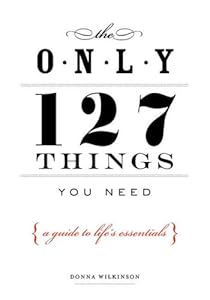
Review of The Only 127 Things You Need


Every once in a while I get the happy “I-can-die-now” feeling, and I honestly feel like if I died in the next few minutes I would be satisfied with life. Other times, death—even a late, natural death—sounds like an insult and even a crime against me and all of humanity. I want that first feeling as much as I can in life, rather than feeling that sick feeling like life is speeding by way too fast and there’s nothing I can do to stop it. It’s not that I want to die before my time, but I want to get my fill of it and have a grateful feeling for life, and not one of resentment towards God, nature, or, worse, myself.

I want to live, as Thoreau put it,

“…deliberately, to front only the essential facts of life, and see if I could not learn what it had to teach, and not, when I came to die, discover that I had not lived. I did not wish to live what was not life, living is so dear; nor did I wish to practice resignation, unless it was quite necessary. I wanted to live deep and suck out all the marrow of life, to live so sturdily and Spartan-like as to put to rout all that was not life, to cut a broad swath and shave close, to drive life into a corner, and reduce it to its lowest terms.”

I know by now that I have to grow used to the music of life flowing on, forever on, and appreciate the change as much as I appreciate the beauty. The change is a part of the beauty! But is there anything we can do to help us soak in every minute and fully appreciate and experience all there is in this short life to experience? Have I been missing out of anything that could potentially have made my life more fully of love, happiness, adventure, and beauty? Can I feel ‘finished’ or at least ‘full’ by the end of life so I don’t have to feel like I have anything left to do? Obviously these questions can’t be answered by a single book, but this is one of the best attempts I’ve seen any author make of cataloging those human needs and desires that must not go unheeded, and making a herculean effort to answer questions and suggest solutions that can help us live the best life we can. While this book looks on the cover to be the latest self-help book with generic information and platitudes about a happy life, I can assure you that there is some real muscle here for the more serious of ‘optimal-life’ connoisseurs.

Wilkinson has researched and solicited advice from the top experts in their fields to provide hard-core information for her readers. That is not to say that I was surprised by everything I read, but if I wasn’t surprised to learn something, it was because I already read about it in other books or health/brain magazines. It’s all legit, and it provides the latest research in all fields. Also, I was very surprised to find it so balanced: hardly anything was emphasized more than it ought to have been, and everything was touched on that I felt needed to be touched on. In other words, nearly all my questions going in were answered! When does that ever happen? And I trusted the advice from Wilkinson and her experts, which is another thing jaded victims of magazine-culture and self-help commercialism have a hard time coming to terms with regarding these types of books.

The “127” in the title was nonsense as a specific number, but it is poking fun at the fact that there are always more things that so-called experts are telling us we need, and this book is hoping to be the apex of up-to-date compendiums for body-mind-soul health…for now. The book is broken into the following sections and topics:

1. Body (food, sleep, exercise, overall wellness, clothing, and shelter and safety.
2. Mind (love and connection, a sense of control, mindfulness and acceptance, authenticity, and mental exercise)
3. Spirit (oneness and connection, reflection, awe and wander, sense of purpose, meaningful ritual)
I honestly can’t think of an area of growth and happiness that was neglected, and it was interesting to read the whole way through. However, as engaging as it was, it may help readers, like it did me, to take the book in piecemeal to better absorb the information. There’s a lot here that could change your life…you don’t want to rush it. Matter of fact, I would go as far as to say that if you truly work at applying what you learn from this book, I don’t see any reason in the world why you wouldn’t be a stronger, happier, more fulfilled person. This stuff works. But don’t take my word for it. Wait, yes, take my word for it. I’m living it.

A word of caution: there is a slant in the last book—Spiritual Health—towards spiritualism, but it quickly generalizes into spiritual health practices for any value/religious system and doesn’t get to metaphysical. Other than that, a specifically spiritual-religious emphasis throughout the book seems to be either non-existent or appropriately subtle.

I have no doubt in my mind that Donna Wilkinson is a very intelligent and happy author who genuinely cares about others and wants to help improve the quality of life of those around her. As a frequent reader of psychology and philosophy, I can tell you that this is really good stuff on a relatively low shelf for readers of all kinds. It’s essential for anyone wanting to better their life, especially for those struggling with negativity, anxiety, or depression.

You know how there’s no ‘owner’s manual’ on life waiting for you when you pop out your mama’s uterus? Well, this might be the closest thing to it.

Thursday, April 17, 2014

Review of The Mind's I


We all laugh at the thought that a machine may one day develop artificial intelligence, or that human consciousness could reside in a remotely controlled body while its brain is back in the lab, or that one’s mental processes could be stored in a book to be accessed by the manual computation of future readers; but embedded in these simple vignettes are deeply unsettling challenges to the way we view human consciousness and even the concepts of soul and self-worth. This book is a test of the endurance of concepts like spirit and consciousness, and if you’ve ever waivered under the onslaught of materialistic reductionism, I promise you this book will come close to kicking out your remaining legs. However, it was supremely entertaining and searching, and ultimately I found it to offer the most beautiful alternatives to a holistic, spiritualized view of existence that I have ever come across. 

Near the beginning of the book the authors had warned of two extremes to avoid: solipsism—the idea that I am the only conscious being in the universe, and Panpsychism—the idea that everything in the universe is conscious. They steered pretty clear of solipsism, and though I would never have expected them to fall into the camp of panpsychism with animists, I truly think they veered towards panpsychism by attributing mind and even suffering to all things which might potentially behave mechanistically like humans do…which includes everything. While trying to avoid falling into the pot of attributing ‘soul’ to a few things, and in their attempt to eliminate the exclusive way soul is applied to only humans, the authors fell into the fire of asserting that everything has soul-like qualities, which is to say that everything has a soul, even if it isn’t traditional way to think about soul. 

Nonetheless, a very pertinent and tenable question is posed that isn’t easily dismissed. Hofstadter gave the analogy of a flame to illustrate the soul dilemma: 

“We just fall like a ton of bricks for the notion that there’s a “soul” in there—a flame-like soul that can flicker on or off, or even be transferred between bodies as a flame between candles. If a candle blows out and is relit, is it “the same flame”? Or, if it stays lit, is it even “the same flame” from moment to moment?”

A flame is a process of combustion, but not a thing separate from fuel or ignition. It’s both process and material, so in some sense a flame lives on, and in another sense it dies and is reborn from moment to moment. The comfort found here, for those who feel the loss of soul in science, is that our bodies and minds are elements continually left in the past, one with new elements added every new instant, and the total process by which these transitions occur and support the process. The continuity which we call soul or consciousness continues in some mysterious way, replacing of cells in our bodies, and over the course of time, replacing our entire body many times over the course of a lifetime. This continuity can even be stretched to an understanding of life beyond death, for just as a flame is blown out, and may be relit later, so it is conceivable that mind may be ‘relit’ and reconstituted after death in a very physical way, given enough time, and maybe in hitherto undreamed ways. We don’t know what consciousness is, or how it got here, and we can’t say it will never make an appearance again. Since we already have the precedent of it being here at all and being conscious, there’s good reason to believe this flame of consciousness will show up again somewhere in this or that universe.

By brilliantly rephrasing the problem of soul, the authors are avoiding a ‘yes/no’ sort of answer, and moving instead toward a radical reinterpretation of soul and self that is consistent with materialistic science. I have to admit, it’s about time. The idea of a soul, as most conceive of it, is an old idea, and was never meant to be plugged into modern scientific formulas. Even as a religious concept it has been, throughout the ages, fraught with complications which for a while people were happy to turn their heads and ignore for the sake of comfort and stability. However, in these days, when bodies live longer and we have the luxury of spending time asking questions and growing into the answers, we don’t have to feel rushed to premature answers lest we die in the process of questioning. The book’s challenges to the ancient concept of soul and spirit is especially valid for our time, if a bit unsettling.

To tackle the difficult and often abstract topics of self and consciousness, the authors—gurus in computer science and philosophy—use imaginative stories and thought experiments to stretch readers’ cerebral muscles, warming them up to start asking questions like, “Who am I? Am ‘I’ a simple monad, with complex feelings, thoughts and acts? Am I fooling myself to think I am a cohesive being with clearly defined boundaries, functions and…worth?” Maybe it’s impossible to simplify our identity—humanity may be, as Hermann Hesse phrased it, “so far from being a unity, is in the highest degree a manifold world, a constellated heaven, a chaos of forms, of states and stages, of inheritances and potentialities”—but this work sure takes the conversation a step forward towards clarity.

Oddly enough, the book started out sounding balanced regarding ideas like holism (universe as soul) and reductionism (universe as machine), citing articles from different perspectives. But the catch—and an awesomely disorienting catch it was—was a HUGE bait-and-switch revealed all the way near the end!

“In this book there are a variety of thought experiments designed to explore the implications of the hypothesis that materialism is true: the mind or self is not another (non-physical) thing, in miraculous interaction with the brain, but somehow a natural and explainable product of the brain’s organization and operation.”

It was a smart move not to reveal this too early. I was actually floored when I realized that the authors were consummate materialists who conceived of the universe and all beings inside it in purely mechanomorphic terms. It seemed to me that they were completely taken-in and driven by Richard Dawkins’ ideas in “The Selfish Gene”, an excerpt from this work provided in chapter 10. Dawkins’ idea is that what we call life is the accidental collision and subsequent survival of enduring combinations of matter; and frankly, I understand why it is the message-thread that weaves through this entire work and probably provided the authors with their premise, however clandestine.  This chapter was my first interaction with Dawkins’ concepts, and I found him to be brilliant and imaginative; and though I personally don’t swallow whole all of his theories—they seem to come up short in attempting to explain the phenomenon of consciousness and will—still, they are as compelling and courageous as anything I’ve seen from a reductionist. 

Because this his hard for people to accept who are accustomed to thinking of the universe in terms of mind, spirit, and free will, the authors attempt to provide a conciliatory and inclusive definition of determinism which encompasses both sides of the debate between soul and body by saying that holism is a view of the world as top-down causality (a sophisticated whole structures the parts), and reductionism is a view of the world as bottom-up causality (the parts are always responsible for the whole, and any final rendering by the whole of the parts is first determined by the parts). The authors attempt to escape the accusation of bias by inserting the Zen idea of “mu”, which “unasks the question” and reveals that “there is a larger context into which both holistic and reductionistic explanations fit.” But really, though mu is a fun concept aimed at assuaging the fears and defenses of holistic thinkers, it’s clear that the authors preponderantly believe we are a random collection of atoms. Still, and maybe in spite of the attempt to introduce-but-minimize it, I found mu to be a very useful way of getting back to the assumptions. By the end, I was actually endeared to mu and to an understanding of the mechanistic process of nature, even in reductionist terms.

Religious or holistic thinkers may ask, how could determinism become endearing to humans who are typically so focused on free will? The key is an understanding that all determined parts are part of the determining whole. One determines as much as one is determined. There is no abstract universe ‘out there’ that is making us. We are as significant a part of the universe as anything else, therefore the universe resides in us. I am the universe in that I am a real part of the whole, and without myself, there is no whole. Therefore, I am the determined part, and the determining whole—both determined and determining. An excerpt from Raymond Smullyan’s dialogue between God and man (chapter 20, “Is God a Taoist?”) helps to illustrate this:

“[God speaking to man] Your acts are certainly in accordance with the laws of nature, but to say they are determined by the laws of nature creates a totally misleading psychological image which is that your will could somehow be in conflict with the laws of nature and that the latter is somehow more powerful than you, and could ‘determine’ your acts whether you liked it or not. But it is simply impossible for your will to ever conflict with natural law. You and natural law are really one and the same…Don’t you see that the so-called ‘laws of nature’ are nothing more than a description of how in fact you and other beings do act? They are merely a description of how you act, not a prescription of how you should act, not a power or force which compels or determines your acts. To be valid, a law of nature must take into account how in fact you do act, or, if you like, how you choose to act…But the confusion is largely caused by your bifurcation of reality into the ‘you’ and the ‘not you’. Really now, just where do you leave off and the rest of the universe begin? Or where does the rest of the universe leave off and you begin?” 

There are definite pros to believing in this kind of determinism:
1. Mind and thought may not be as unique to human experience as previously thought; but nor are we as alone, isolated, and unsolvable as previously thought.
2. We may not have souls; but whatever it is we do have, nature has a lot of material to make more for a long time, again and again.
3. We may be determined, but we are also integral to, and synonymous with, the determining whole. 

Whether or not one finds the ideas in the book to be palatable, it certainly is a wild ride nonetheless. The best chapters in the book are, in order of appearance:

On Having No Head—A fun and strangely convincing essay about the myth we have all bought into that tells us we have heads. It’s a hoax! We’ve never seen our heads, and our subjective perspective eliminates the option of us experiencing our own heads as objects. Genius.

The Turing Test—The famous Turing Test fable which first appeared in Scientific American in 1981. Are we sure that computers won’t ever be able to think like humans? This hypothetical test will leave you wondering.

Selfish Genes and Selfish Memes (by Richard Dawkins)—A must read about how mind may have been formed by the ‘mindless’ evolution of particles which clumped together to form 6 forms of stability: longevity/fecundity/copying-fidelity/competition/combination/colonization. Much emphasis is laid on the human body as a survival machine, future thought as simulated models of trial and error, and memes as transmittable culture (ideas) which is currently the most advanced form of evolution and self-replication. The Selfish Gene is probably the seminal work which forms the undercurrent for the entire present volume. 

Prelude…Ant Fugue—Very creative, if hard-to-read-at-times, analogy about how the brain works somewhat ‘accidentally’ to form a holistic system that appears to be conscious as a whole when really it is only as conscious as a stone. Brilliant.

The Story Of a Brain— A brain is kept alive in a nutrient bath beyond the death of the body, and the brain is stimulated artificially to provide ‘experiences’. Eventually the brain is broken up into halves, parts, and finally into separate neurons which were replaced when they wore out. Is it the same brain when replaced neuron by neuron? Is it still conscious? 

Where Am I/ Where was I?— A brain is removed from its body and the body is sent into hazardous situations. Consciousness is generated by the brain, but resides in the body. Eventually the body is replaced with new bodies. Is consciousness in the body, brain, or neither? Which body is my body?

The Riddle Of the Universe And Its Solution—An infectious thought is sending people into catatonic states, and scientists try to isolate the idea in media before they succumb. An analogy to unsolved paradoxes that tangles people’s thoughts and hamstrings basic logic. Is this recurring feedback what creates consciousness?

Is God a Taoist?— A man has a very unpredictable discussion with God. God redefines man’s idea of free will, suffering, and evil. The redefinitions of theistic and humanistic ideas are astounding and very useful. 

An Unfortunate Dualist—A man takes a drug to kill his soul because he no longer wants to live, but the drug helps the body and brain continue on as normal so a bodily suicide does not negatively impact others. What happens to consciousness?

What Is it Like To Be a Bat?—Philosopher Thomas Nagel speculates on what it is like to be a bat, and determines that we can’t really know what it is like to be anything other than ourselves. The problem of subject/object duality and relation needs to be explored more.

An Epistemological Nightmare— An epistemologist builds a brain-reading machine and ends up being driven crazy by it because people’s meanings, and even one’s own internal meanings, are so varied.

A Conversation With Einstein’s Brain— Best chapter in the book! This one really blew my mind. Imagine if Einstein’s brain was catalogued into book with a separate page for every neuron including its threshold values, resistance values, structural change calculations etc. If we input data from a spoken question like, “Hello Einstein, how are you?”, would one be able to run the data through the book to compute a response from Einstein’s brain to contemporary conversation partners? If so, would that make Einstein dead or alive? It’s a trap!

Fiction—All characters in a story are the author’s thoughts, and therefore, in some sense, are the author. Does the author’s meaning change the character’s feeling about their part in the story? Do we feel our part in the story of life is changed if the state of the author (ourselves or God) is changed?

The structure of the book was very helpful. Introductions were provided for topics, then vignettes illustrated the topics, and these were followed by a reflection by the authors to help readers distill the take-aways. The philosophical gleanings were bountiful, and the challenges to traditional ways of thinking about humanity and human consciousness were well worth the work. 

Bottom line: what do we really know about consciousness and mind? Very little as it turns out, but enough to rule out, according to the authors, antiquated ideas about soul. Still, the subjective-objective tension, and the balance between holism and reductionism keeps this matter from being over-simplified and conclusive. What do we really know about other people’s conscious experience in general? What do we really know about our own past conscious experience, say, even 5 years ago? As one author states, “When you come right down to it, it’s not so clear just what it is like to be me, right now.”