Thursday, April 17, 2014

Review of The Mind's I


We all laugh at the thought that a machine may one day develop artificial intelligence, or that human consciousness could reside in a remotely controlled body while its brain is back in the lab, or that one’s mental processes could be stored in a book to be accessed by the manual computation of future readers; but embedded in these simple vignettes are deeply unsettling challenges to the way we view human consciousness and even the concepts of soul and self-worth. This book is a test of the endurance of concepts like spirit and consciousness, and if you’ve ever waivered under the onslaught of materialistic reductionism, I promise you this book will come close to kicking out your remaining legs. However, it was supremely entertaining and searching, and ultimately I found it to offer the most beautiful alternatives to a holistic, spiritualized view of existence that I have ever come across. 

Near the beginning of the book the authors had warned of two extremes to avoid: solipsism—the idea that I am the only conscious being in the universe, and Panpsychism—the idea that everything in the universe is conscious. They steered pretty clear of solipsism, and though I would never have expected them to fall into the camp of panpsychism with animists, I truly think they veered towards panpsychism by attributing mind and even suffering to all things which might potentially behave mechanistically like humans do…which includes everything. While trying to avoid falling into the pot of attributing ‘soul’ to a few things, and in their attempt to eliminate the exclusive way soul is applied to only humans, the authors fell into the fire of asserting that everything has soul-like qualities, which is to say that everything has a soul, even if it isn’t traditional way to think about soul. 

Nonetheless, a very pertinent and tenable question is posed that isn’t easily dismissed. Hofstadter gave the analogy of a flame to illustrate the soul dilemma: 

“We just fall like a ton of bricks for the notion that there’s a “soul” in there—a flame-like soul that can flicker on or off, or even be transferred between bodies as a flame between candles. If a candle blows out and is relit, is it “the same flame”? Or, if it stays lit, is it even “the same flame” from moment to moment?”

A flame is a process of combustion, but not a thing separate from fuel or ignition. It’s both process and material, so in some sense a flame lives on, and in another sense it dies and is reborn from moment to moment. The comfort found here, for those who feel the loss of soul in science, is that our bodies and minds are elements continually left in the past, one with new elements added every new instant, and the total process by which these transitions occur and support the process. The continuity which we call soul or consciousness continues in some mysterious way, replacing of cells in our bodies, and over the course of time, replacing our entire body many times over the course of a lifetime. This continuity can even be stretched to an understanding of life beyond death, for just as a flame is blown out, and may be relit later, so it is conceivable that mind may be ‘relit’ and reconstituted after death in a very physical way, given enough time, and maybe in hitherto undreamed ways. We don’t know what consciousness is, or how it got here, and we can’t say it will never make an appearance again. Since we already have the precedent of it being here at all and being conscious, there’s good reason to believe this flame of consciousness will show up again somewhere in this or that universe.

By brilliantly rephrasing the problem of soul, the authors are avoiding a ‘yes/no’ sort of answer, and moving instead toward a radical reinterpretation of soul and self that is consistent with materialistic science. I have to admit, it’s about time. The idea of a soul, as most conceive of it, is an old idea, and was never meant to be plugged into modern scientific formulas. Even as a religious concept it has been, throughout the ages, fraught with complications which for a while people were happy to turn their heads and ignore for the sake of comfort and stability. However, in these days, when bodies live longer and we have the luxury of spending time asking questions and growing into the answers, we don’t have to feel rushed to premature answers lest we die in the process of questioning. The book’s challenges to the ancient concept of soul and spirit is especially valid for our time, if a bit unsettling.

To tackle the difficult and often abstract topics of self and consciousness, the authors—gurus in computer science and philosophy—use imaginative stories and thought experiments to stretch readers’ cerebral muscles, warming them up to start asking questions like, “Who am I? Am ‘I’ a simple monad, with complex feelings, thoughts and acts? Am I fooling myself to think I am a cohesive being with clearly defined boundaries, functions and…worth?” Maybe it’s impossible to simplify our identity—humanity may be, as Hermann Hesse phrased it, “so far from being a unity, is in the highest degree a manifold world, a constellated heaven, a chaos of forms, of states and stages, of inheritances and potentialities”—but this work sure takes the conversation a step forward towards clarity.

Oddly enough, the book started out sounding balanced regarding ideas like holism (universe as soul) and reductionism (universe as machine), citing articles from different perspectives. But the catch—and an awesomely disorienting catch it was—was a HUGE bait-and-switch revealed all the way near the end!

“In this book there are a variety of thought experiments designed to explore the implications of the hypothesis that materialism is true: the mind or self is not another (non-physical) thing, in miraculous interaction with the brain, but somehow a natural and explainable product of the brain’s organization and operation.”

It was a smart move not to reveal this too early. I was actually floored when I realized that the authors were consummate materialists who conceived of the universe and all beings inside it in purely mechanomorphic terms. It seemed to me that they were completely taken-in and driven by Richard Dawkins’ ideas in “The Selfish Gene”, an excerpt from this work provided in chapter 10. Dawkins’ idea is that what we call life is the accidental collision and subsequent survival of enduring combinations of matter; and frankly, I understand why it is the message-thread that weaves through this entire work and probably provided the authors with their premise, however clandestine.  This chapter was my first interaction with Dawkins’ concepts, and I found him to be brilliant and imaginative; and though I personally don’t swallow whole all of his theories—they seem to come up short in attempting to explain the phenomenon of consciousness and will—still, they are as compelling and courageous as anything I’ve seen from a reductionist. 

Because this his hard for people to accept who are accustomed to thinking of the universe in terms of mind, spirit, and free will, the authors attempt to provide a conciliatory and inclusive definition of determinism which encompasses both sides of the debate between soul and body by saying that holism is a view of the world as top-down causality (a sophisticated whole structures the parts), and reductionism is a view of the world as bottom-up causality (the parts are always responsible for the whole, and any final rendering by the whole of the parts is first determined by the parts). The authors attempt to escape the accusation of bias by inserting the Zen idea of “mu”, which “unasks the question” and reveals that “there is a larger context into which both holistic and reductionistic explanations fit.” But really, though mu is a fun concept aimed at assuaging the fears and defenses of holistic thinkers, it’s clear that the authors preponderantly believe we are a random collection of atoms. Still, and maybe in spite of the attempt to introduce-but-minimize it, I found mu to be a very useful way of getting back to the assumptions. By the end, I was actually endeared to mu and to an understanding of the mechanistic process of nature, even in reductionist terms.

Religious or holistic thinkers may ask, how could determinism become endearing to humans who are typically so focused on free will? The key is an understanding that all determined parts are part of the determining whole. One determines as much as one is determined. There is no abstract universe ‘out there’ that is making us. We are as significant a part of the universe as anything else, therefore the universe resides in us. I am the universe in that I am a real part of the whole, and without myself, there is no whole. Therefore, I am the determined part, and the determining whole—both determined and determining. An excerpt from Raymond Smullyan’s dialogue between God and man (chapter 20, “Is God a Taoist?”) helps to illustrate this:

“[God speaking to man] Your acts are certainly in accordance with the laws of nature, but to say they are determined by the laws of nature creates a totally misleading psychological image which is that your will could somehow be in conflict with the laws of nature and that the latter is somehow more powerful than you, and could ‘determine’ your acts whether you liked it or not. But it is simply impossible for your will to ever conflict with natural law. You and natural law are really one and the same…Don’t you see that the so-called ‘laws of nature’ are nothing more than a description of how in fact you and other beings do act? They are merely a description of how you act, not a prescription of how you should act, not a power or force which compels or determines your acts. To be valid, a law of nature must take into account how in fact you do act, or, if you like, how you choose to act…But the confusion is largely caused by your bifurcation of reality into the ‘you’ and the ‘not you’. Really now, just where do you leave off and the rest of the universe begin? Or where does the rest of the universe leave off and you begin?” 

There are definite pros to believing in this kind of determinism:
1. Mind and thought may not be as unique to human experience as previously thought; but nor are we as alone, isolated, and unsolvable as previously thought.
2. We may not have souls; but whatever it is we do have, nature has a lot of material to make more for a long time, again and again.
3. We may be determined, but we are also integral to, and synonymous with, the determining whole. 

Whether or not one finds the ideas in the book to be palatable, it certainly is a wild ride nonetheless. The best chapters in the book are, in order of appearance:

On Having No Head—A fun and strangely convincing essay about the myth we have all bought into that tells us we have heads. It’s a hoax! We’ve never seen our heads, and our subjective perspective eliminates the option of us experiencing our own heads as objects. Genius.

The Turing Test—The famous Turing Test fable which first appeared in Scientific American in 1981. Are we sure that computers won’t ever be able to think like humans? This hypothetical test will leave you wondering.

Selfish Genes and Selfish Memes (by Richard Dawkins)—A must read about how mind may have been formed by the ‘mindless’ evolution of particles which clumped together to form 6 forms of stability: longevity/fecundity/copying-fidelity/competition/combination/colonization. Much emphasis is laid on the human body as a survival machine, future thought as simulated models of trial and error, and memes as transmittable culture (ideas) which is currently the most advanced form of evolution and self-replication. The Selfish Gene is probably the seminal work which forms the undercurrent for the entire present volume. 

Prelude…Ant Fugue—Very creative, if hard-to-read-at-times, analogy about how the brain works somewhat ‘accidentally’ to form a holistic system that appears to be conscious as a whole when really it is only as conscious as a stone. Brilliant.

The Story Of a Brain— A brain is kept alive in a nutrient bath beyond the death of the body, and the brain is stimulated artificially to provide ‘experiences’. Eventually the brain is broken up into halves, parts, and finally into separate neurons which were replaced when they wore out. Is it the same brain when replaced neuron by neuron? Is it still conscious? 

Where Am I/ Where was I?— A brain is removed from its body and the body is sent into hazardous situations. Consciousness is generated by the brain, but resides in the body. Eventually the body is replaced with new bodies. Is consciousness in the body, brain, or neither? Which body is my body?

The Riddle Of the Universe And Its Solution—An infectious thought is sending people into catatonic states, and scientists try to isolate the idea in media before they succumb. An analogy to unsolved paradoxes that tangles people’s thoughts and hamstrings basic logic. Is this recurring feedback what creates consciousness?

Is God a Taoist?— A man has a very unpredictable discussion with God. God redefines man’s idea of free will, suffering, and evil. The redefinitions of theistic and humanistic ideas are astounding and very useful. 

An Unfortunate Dualist—A man takes a drug to kill his soul because he no longer wants to live, but the drug helps the body and brain continue on as normal so a bodily suicide does not negatively impact others. What happens to consciousness?

What Is it Like To Be a Bat?—Philosopher Thomas Nagel speculates on what it is like to be a bat, and determines that we can’t really know what it is like to be anything other than ourselves. The problem of subject/object duality and relation needs to be explored more.

An Epistemological Nightmare— An epistemologist builds a brain-reading machine and ends up being driven crazy by it because people’s meanings, and even one’s own internal meanings, are so varied.

A Conversation With Einstein’s Brain— Best chapter in the book! This one really blew my mind. Imagine if Einstein’s brain was catalogued into book with a separate page for every neuron including its threshold values, resistance values, structural change calculations etc. If we input data from a spoken question like, “Hello Einstein, how are you?”, would one be able to run the data through the book to compute a response from Einstein’s brain to contemporary conversation partners? If so, would that make Einstein dead or alive? It’s a trap!

Fiction—All characters in a story are the author’s thoughts, and therefore, in some sense, are the author. Does the author’s meaning change the character’s feeling about their part in the story? Do we feel our part in the story of life is changed if the state of the author (ourselves or God) is changed?

The structure of the book was very helpful. Introductions were provided for topics, then vignettes illustrated the topics, and these were followed by a reflection by the authors to help readers distill the take-aways. The philosophical gleanings were bountiful, and the challenges to traditional ways of thinking about humanity and human consciousness were well worth the work. 

Bottom line: what do we really know about consciousness and mind? Very little as it turns out, but enough to rule out, according to the authors, antiquated ideas about soul. Still, the subjective-objective tension, and the balance between holism and reductionism keeps this matter from being over-simplified and conclusive. What do we really know about other people’s conscious experience in general? What do we really know about our own past conscious experience, say, even 5 years ago? As one author states, “When you come right down to it, it’s not so clear just what it is like to be me, right now.”

Tuesday, February 18, 2014

Review of Introducing Wittgenstein


For those of you who don’t know, the “Introducing” series published by Toten Books is a graphic novel presentation of big ideas and their thinkers. They are fun to read and a huge help for visual learners. It’s true there isn’t as much information as could fit onto a fully-worded page, but it makes up in mnemonic assistance what it lacks in exhaustive content. Also, because there isn’t as much emphasis placed on written content as pictorial interpretation, the effort to highlight central concepts is predominant. It almost felt in parts that this was Wittgensteinian philosophy in outline form, which definitely has its perks. Though, I won’t lie, it did at times teeter on the edge of skimming ideas that really require much more explanation, for the most part it provided an adequate amount. The worst part of it all is that some of the illustrations were entirely gratuitous, obviously designed to fill up space, and had very little to do with the topic; but even then they help you to remember what you learned on that page even if by their utter pointlessness. Which brings me back to my point that this book  is extremely helpful as a memory tool for primary principles, and since I read it in conjunction with excerpts from Wittgenstein’s Tractatus and Philosophical Investigations (which I highly recommend), it served as a very enjoyable reinforcement for my understanding. 

Wittgenstein was a genius, no doubt. This guy was raised in one of the wealthiest families in Vienna. He was seriously rich. His family had popular composers and artists over to the house all the time. After the war, the family increased in wealth as a result of smart stock investments in the U.S. But none of that is interesting in and of itself; what is interesting is that none of this determined Ludwig as a sybarite and dandy. When WWI broke out, he volunteered to fight on the frone lines, and even then, when first seeing the enemy on the battlefield, he wrote, “Now I have a chance to be a decent human being, for I am standing eye to eye with death.” When he was finally taken as a prisoner of war, he refused to accept his release until the men under his command were released with him. He even requested to be transferred from his camp to another to assist his countrymen who had contracted typhoid. Now here’s a man who, when he has something to say, makes one listen.

Wittgenstein began his education and career path as an engineer, with a penchant for mathematics. His love of solving problems led him ultimately into philosophy. Many big philosophers back in the day were wealthy aristocrats, as large fortunes and prestige bring with them ample opportunities for educational advancement, recognition, and easy publication of their ideas. Bertrand Russell, Wittgenstein’s mentor, was a very good example of this. But although Wittgenstein was probably one of the more wealthy philosophers in the pool of contenders across the ages, he determined not to think from the comfort of his couch. His Tractatus Logico-Philosophicus (Latin for "Logical-Philosophical Treatise"), his first opus for which he was awarded a doctorate, was written while he was fighting on the front lines! His later work, Philosophical Investigations, was published posthumously from his lectures, and is quintessentially the heroic Wittgenstein to its core in that it unsparingly and unflinchingly debunked his own first work!

I have a lot of respect for this man, even though he made some really dumb mistakes. While he was teaching in a poor village in Austria, supposedly out of the goodness of his heart, he apparently caned boys and pulled girls’ hair for wrong answers. That is most definitely NOT cool, even though the word caning makes me laugh. He was described by Russell as an intense, volatile, and “domineering” genius. Russell was often seriously concerned about Wittgenstein’s mental physical health due to his obsessive compulsiveness and distress over thought-problems. Biographers of Wittgenstein’s famous disagreement with Karl Popper (see my review of Wittgenstein’s Poker at http://bookburningservice.blogspot.com/2014/02/review-of-wittgensteins-poker.html) have him wielding a hot poker at Popper for frustrating him during a routine classroom debate at the Moral Science Club, which meetings Wittgenstein was famous for crashing. But, despite losing face at the poker-debate, Wittgenstein didn’t commit suicide like his other three brothers, so… Point—Wittgenstein (Ludwig).

His non-corporeal teaching methods and views on academia were the most intriguing part of his life for me. His students described his style as discursive and spontaneous. He would wrestle with questions out-loud, and invite his students into working towards the answers with him right then and there. He wanted learning to be organic and hands-on as much as possible, which probably stemmed from his engineering background. He loathed the artifice and hubris of academic atmospheres, and believed that they often encouraged hypotheticals, tautologies, and specious reasoning which diverged widely from a real world with real problems. His style was the kind in which thought and language experiments (games) teased new solutions out of his mind and the minds of his students. He endeavored to work in concert with the brain, instead of bridling the mind’s full potential within the confines of formalities and structures designed to impress other people and build an institution’s reputation. He preferred real learning in the face of paper degrees, professorial bluster, and servile gpa-performance.

As I mentioned before, in tandem with reading Introducing Wittgenstein I also read selections from Wittgenstein’s Tractatus Logico-Philosophicus and Philosophical Investigations. The difficulty of a layman comprehending these texts is evidenced in the first few sentences of Wittgenstein’s preface to the Tractatus which included the quasi-caution, “Perhaps this book will be understood only by someone who has himself already had the thoughts that are expressed in it—or at least similar thoughts…Its purpose would be achieved if it gave pleasure to one person who read and understood it”; but his obvious lack of confidence in anyone being able to perfectly accomplish that feat was demonstrated as he patted his examiners G.E. Moore and Bertrand Russell on the back the moment after they awarded him a PhD for it, saying to them, “Don’t worry, I know you’ll never understand it.”

One of the things I came across in this my second reading of the excerpts of Wittgenstein’s Tractatus and Philosophical Investigations is his defense of common parlance against academic definitions. He attacks again and again the dissection of life for the sake of science. Life is best known when it is lived, and language is best studied as it is spoken and used, although there is some limited value in specification and definition. 

To repeat, we can draw a boundary—for a special purpose. Does it take that to make the concept usable? Not at all! (Except for that special purpose.) No more than it took the definition: 1 pace = 75 cm. to make the measure of length ‘one pace’ usable. And if you want to say “But still, before that it wasn’t an exact measure”, then I reply: very well, it was an exact one. –Though you still owe me a definition of exactness…Is it even always an advantage to replace an indistinct picture by a sharp one? Isn’t the indistinct one often exactly what we need? (Philosophical Investigations)

However, Wittgenstein didn’t believe vagueness was always our only option, just that it was often true to the world we find ourselves in. Responding to the very real need of discovering and formulating more precise definitions at times, Wittgenstein says that there are very workable “family resemblances” between words and ideas, long before an artificial definition is set up as a warden to prevent meaning from leaking out. Consider words like ‘good’. He says that “there is no one common property which the word good refers to. But there are resemblances between the various meanings of the term—like family resemblances” (Introducing Wittgenstein). These ‘family resemblances’ are the foundation for any definition we might come up with, and it’s best we get comfortable with this notion, because it’s the way cognition operates fundamentally. “We give examples of similarities and do not attempt to define them, as there are no sharp boundaries” (IW).

It may sound profound to some, or like linguistic sacrilege to others, but really, how could anyone have missed the simple truism of everyday life that every word in every mouth means something a bit different? If twenty different people use supposedly the same word to indicate twenty slightly different things, with twenty different reasons to use it, and hundreds of unique personal experiences to help define it, which passed through thousands of different meanings from different people and their own personal experiences, then why would we think a dead dictionary or an isolated professor at his lonely desk in a quiet room would ever know enough about that word and its myriad meanings to tell a person what they meant when they used it in that one unrepeatable instant? We now see the problem Wittgenstein was highlighting, for he was always keen on turning “latent nonsense into patent nonsense.”

No doubt some good ole’ professor can arrive some original sense in our word. “[Oftentimes] the kinship [between two somewhat ‘vague’ categories like color] is just as undeniable as the difference. (PI)”, but let our esteemed lexicographers take care how they go about measuring something that’s still alive, moving, and growing.

Imagine having to sketch a sharply defined picture ‘corresponding’ to a blurred one…In such a difficulty always ask yourself: How did we learn the meaning of this word (“good” for instance)? From what sort of examples? In what language-games [unique word-play and personal communication scenarios]? Then it will be easier for you to see that the word must have a family of meanings. (PI)

The language idea basically boils down to the simple problem of thinking and ideas: thinking does not constitute reality. Our internal models of the universe are not the universe. The most complete and explicit data to be had about the universe...IS the universe. You’re welcome.


Wittgenstein, along with writers/thinkers like Jean-Paul Sartre, were the anti-academic, anti-elitist voices who challenged the high thinking and low living of many of their aristocratic contemporaries. He was unwieldy, but probably in a way that kept those around him honest and, well, caught. He was the people’s man in high places, and many will never know how successfully he may have grounded the intelligentsia from a tyrannical control of ideas which belong to the instinctual rabble as much as anyone. Who knows where fascist, top-down oppression and manipulation would occur next if not for representatives of the common man acting as saboteurs and ‘inside men’ to disrupt the haughty detachment that often infects the privileged. Wittgenstein was a hero. When he wasn’t teaching in remote villages in Austria. Or wielding hot pokers at visiting lecturers.

Review of Wittgenstein's Poker


A beginner-friendly and amusing introduction to 20th century philosophy, the study of which can often be so abstruse, and eventually so specialized, that pursuing this subject often only interests the most diehard of academics. However, the setting for this book’s approachable overview of that era’s central philosophical perspectives is the legendary clash between Ludwig Wittgenstein and Karl Popper. When these two intellectual behemoths tangled, the concussion was enough to stun, enrage, and embitter those in attendance at was supposed to be an ordinary night of lecture and debate at the Moral Science Club at Cambridge. It is amazing to read the near-thespian pettiness of the fallout in the form of letters written years later by witnesses that attempt to vindicate the reputation of one rival or the other, and the first-hand accounts that were later censured for their own colorful version of the episode keep it sweet, scandalous, and still-around to be circulated for another hilarious century or two.

Wittgenstein, the rival that attracts most people to the debate, as the title suggests, is probably the most-renowned name in all of modern philosophy and has been placed by many in the pantheon of the most powerful wizards of all time. Oops, I mean ‘philosophers’. His ideas are often hard to comprehend by the uninitiated. He was often harshly criticized by his colleagues and philosophical “equals” (my quotations added to expose their mommas’ assurances that Wittgenstein “was just jealous”) as esoteric, so if they had a hard time understanding him, one can understand why, for the rest of us, trying to learn his philosophy is daunting at first. This book, however, was a cordial welcome to understand the man behind the ideas, and it offered a chewed up (and digested I’m sure) version of his contributions to philosophy that a layman can appreciate. Concepts positing language as a labyrinthine fly bottle, a linguistic puzzle that must be solved to get at a basic understanding of life, become quickly interesting when employed as veritable hoots and hollers fomenting a schoolyard brawl between two champions while readers like myself circle around and prevent any escape.

Karl Popper was the challenger. Popper is almost a no-name in philosophy today, especially when sized next to Wittgenstein’s titanic presence as probably the greatest revolutionary since Immanuel Kant. Popper's primary achievements were countering the methods of logical positivism which were much in vogue at the time, though his philosophy may look to some as the same. He contended that philosophical problems do indeed exist, as opposed to Wittgensteinian language ‘puzzles’ that he felt keeps one from committing to some sense of reality. Wittgenstein would say, rather, that he was “turning latent nonsense into patent nonsense’.

In my estimation, it seemed like both of the philosophers were jerks, as corroborated by the testimony of those closest to them! My final verdict, though, is that Popper appeared more resentful and angry than Wittgenstein (as limned by the authors), while Wittgenstein’s egoism seems to have been provoked by the insouciant philosophy and aloof, self-righteous inaction of higher academics. It may not have been detrimental in all cases that Wittgenstein viewed himself as a hero succoring philosophy from the hands of crooked and careless masters, validating the common man who needs practical understanding, hope, and some amount of genuine trust in himself to make better choices.


Fascinating story, and immensely helpful in broaching big ideas.

Tuesday, January 14, 2014

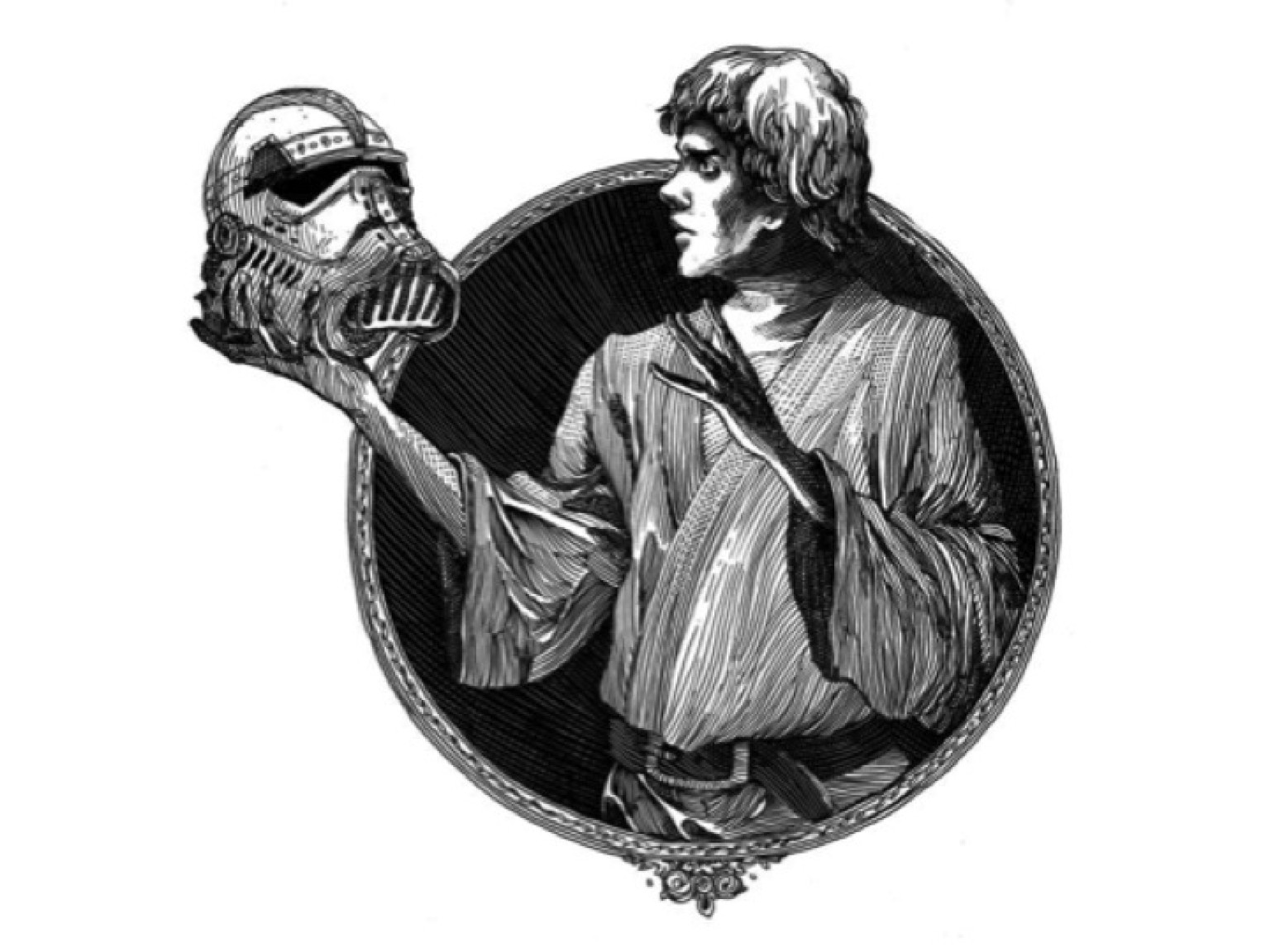
Review of Shakespeare's Star Wars


Bustin’ a stitch doth make the hours seem short. I asked for this book for Christmas for shins and grins, and it didn’t disappoint…too much. The Shakespearean soliloquys, true to form, drew out new flavors in complex character development. It was fun to have someone like Doescher, who is invested in the Star Wars saga on a personal level and also well-acquainted with the expert storytelling of Shakespeare, retell a classic tale in a style which brings to light things I never caught the first time when watching the films. But mostly, it was just funny.

Some lines which almost madeth me to lose my continence:

[Luke] “But unto Tosche Station would I go, and there obtain some pow’r converters. Fie!”

[OBI-WAN] “…these are not the droids for which thou search’st.”

[Luke insulting the Millennium Falcon] “What folly-fallen ship is this? What rough-hewn wayward scut is here?”

[C-3PO to Han when Han explained a Wookie’s temper] “Thy meaning, Sir, doth prick my circuit board. ‘Tis best to play the fool, and not the sage…[to R2] pray let the Wookie win.”

[Leia to Luke upon first seeing him in a Stormtrooper’s armor] “Does Empire shrink for want of taller troops?”

[Han getting fed up with Leia’s complaints—can you blame him?] “Mayhap thy Highness would prefer her cell?”

And Doescher made a nice display of ‘the music in himself’ by incorporating well-known lines from Grandpa Bard himself: 

[Beginning of the first scene, the rebel ship is being attacked, C-3PO is talking] “Now is the summer of our happiness, made winter by this sudden, fierce attack!”

[Luke asking about the blinking lights on the Falcon’s dashboard, which signified the loss of their deflector shield] “What light through yonder flashing sensor breaks?"
[Luke, encouraging other X-Wing pilots on their final attack on the Death Star] “Once more unto the trench, dear friends, once more!”

I loved how R2-D2 played a very prominent role as a secret conspirator and possibly the real lynchpin to the whole narrative, saving everyone’s skin, especially his petty and berating friend, C-3PO, on more than one occasion. He was able to speak intelligibly in soliloquy when aside, but in front of others he spoke only in beeps and boops.

“Around both humans and the droids I must be seen to make such errant beeps and squeaks, that they shall think me simple. Truly, though, although with sounds oblique I speak to them, I clearly see how I shall play my part, and how a vast rebellion shall succeed by wit and wisdom of a simple droid.”

Ah, R2. A doormat to some thou seemedst, yea, a small square of toilet tissue even, through which one’s fingers’ doth break. But Shakespeare spoke of thee truly: "This fellow is wise enough to play the fool."

Some parts of the book almost startled me by their profundity:

[OBI-WAN is speaking aside to himself about Luke] What shall I of the father tell the child? If gentle Luke knew all that’s known to me I’ll warrant he’d not understand the rhyme and reason for my words. And yet, what is’t to lie? To tell the truth, all else be damned? Or else to tell, perhaps, a greater truth?”

After this part in particular, it dawned upon me how many people misled (lied) to Luke about his or their identity, even if for a short time. His uncle, OBI-WAN, Yoda, Darth Vader…yeah, all the people that mattered. But OBI-WAN in his soliloquy believes that the full weight of the truth wouldn’t have been accepted or recognized immediately by Luke even if he had heard it. Then again, maybe OBI-WAN was just being a drama queen. He did, after all, do things like pretend to look and sound like a monster to scare away the sand people instead of just confusing them with a Jedi mind trick, told the guy threatening Luke that Luke was a “little one” and wasn’t even “worth the effort”, tried to negotiate cooly with Han Solo, but ended up congratulating himself on offering Han 7,000 (of Leia’s money) more than Han asked for, called Darth Vader “Darth”, as if ‘Darth’ was a first name and not a title, and allowed himself to be chopped in half by Vader as if he was surrendering when it was very clear that Vader was winning anyway. So, yeah, maybe he was a little bit of a drama queen. Now, where was I?

The most hilarious scene is where two Stormtroopers are debating back-and-forth about whether or not there were still people aboard the Millennium Falcon after it had been brought into the Death Star and inspected. One Stormtrooper convinces the other that his worry is just an over-active imagination.

Guard 1: Thou art a friend, as I have e’er maintain’d, and thou hast spoken truth and calm’d me quite. The rebels hide herein! What vain conceit! That e’er they should the Death Star enter—ha! 
Guard 2: It warms my heart to see thee so restor’d, and back to thine own merry, native self. 
Han: [within] Pray, may we have thy good assistance here?
Guard 1: [to Guard 2] So, let us go together, friend. Good cheer! [Guards 1 and 2 enter the ship and are killed.]

Yet, as with many other books, what began so well, ended too soon. The first half was extremely amusing, and there were some moments that kept it interesting throughout (e.g. Luke’s soliloquy to the mask of a Stormtrooper whom he killed for the uniform), but it started to drag. Maybe it took itself too seriously? The author never strayed from iambic pentameter, and though that is indeed a feat, it’s a rather uninteresting one to me, and limited Doescher’s options. Or maybe, I’m thinking, he knew that this book was only going to be interesting as a novelty, and never in his wildest dream expected anyone as big a nerd as me to read it from beginning to end but only read excerpts out-loud to guffawing friends.

Well, I love Shakespeare, and I love Star Wars, so the idea as a whole was a good fit for me. Not sure I’ll read the next book if it comes out, but I may change my mind. Maybe the novelty hasn’t completely worn off. But for now, parting is more sweet than sorrow.

Sunday, January 12, 2014

Review of Slaughterhouse Five


No doubt about it, Vonnegut is an extremely talented writer who knows how to bolt a reader’s butt to the seat. He’s intelligent enough to know that other intelligent people don’t want the same old thing written in the same old way. In Slaughterhouse Five our boy Kurt keeps things fresh and moving the whole way. It is a spellbinding display of creativity, facetiousness, profundity, and meta-storytelling. He plays with writing the way the Globetrotters (are they still around?) play basketball: he makes a circus out of the things that other people take WAY too seriously. Why does he do this? Because he can. This guy may never have followed with gusto the ‘Robert’s Rules Of Order: Writer’s Edition’, partly because he sees that rules are, from the very beginning, all just a big joke. Then again, he doesn’t give the impression that he doesn’t understand the rules, but rather that he has out-grown them. It’s as if he had played within the archaisms of traditionally structured fiction/non-fiction for far too long, and was ready to create something new.

His characters are unpredictable and the plot is sci-fi mixed with some of his own biography. Vonnegut was writing loosely about his experiences in WWII prison camps and about the fire-bombing of Dresden (which killed more people than the atomic bombing of Nagasaki and Hiroshima put together), but he was also writing what he felt and thought, as if his haphazard thoughts were actual events (beyond stream-of-thought), contorting characters into hysterics that made you want to weep in one paragraph, and laugh in the next. Sometimes, he included bland factual information, definitions even, to make it all feel as authentic and pointless as life itself sometimes is experienced. In this aspect his genius is especially showcased. He understood that stories are artificial re-structuring of events that were initially manifested as meaningless or inhumane accidents—inhumane in the sense that human beings are not announced in the mundane as the center of the mystery of life, and may not even be a clue to life’s meaning. Histories and ‘nonfiction’ are posthumous renderings of happenings that had no storyteller there to say how to process it for food or hope, and they recreate an angle from which to view events as if there were spectators and stadium seating all along. At the beginning of the book he writes:

“It is so short and jumbled and jangled, Sam, because there is nothing intelligent to say about a massacre. Everybody is supposed to be dead, to never say anything or want anything ever again. Everything is supposed to be very quiet after a massacre, and it always is, except for the birds.”

Fear, suffering, and death do not have narrators, only stories do. And stories are not lived, they are told after they are all dead and gone (a la Sartre). Vonnegut senses this disjunction between what we live and what we tell, and attempts to imitate the feelings of live living in a disjointed, discursive, personal-impersonal style that is fun and engaging.

The whole idea of time-travel and aliens (Tralfamadorians) frees the author up to pull just about any literary stunt legally. It’s his way of saying, “Let me tell the story how I want to tell it. If it helps, just pretend the protagonist could time travel and was abducted by aliens at some point.” I love how the Tralfamadorians were so entertained by human perspective. They helped Billy understand how precious life was—how precious his life was—even to the extent of upending his idea of body-image.

“Most Tralfamadorians had no way of knowing Billy’s body and face were not beautiful. They supposed that he was a splendid specimen. This had a pleasant effect on Billy, who began to enjoy his body for the first time.”

They also explained to Billy that humanity’s provincial viewpoint is like looking at a landscape through a long, narrow pipe which is fastened to a train moving continually, never backing up, showing people like Billy only part of the whole picture in a constantly shifting, miniature window to the world. This is how Vonnegut probably conceives of time and the limited scope of human understanding. Sounds about right to me. Though, if these aliens are metaphors for a broader perspective, Vonnegut's not doing a good job of following their advice, and I think for good reason. He writes, "there is nothing intelligent to say about a massacre," and later, "That's one thing Earthlings might learn to do, if they tried hard enough: Ignore the awful times, and concentrate on the good ones"; but apparently 'think nice thoughts' isn't as convincing practically as it sounds rhetorically. How do I know?  Because Vonnegut wrote a book about the fire-bombing of Dresden. Microphone dropped. 

I loved the ‘Vonuguttian’ spin on characters and events throughout history, and especially his view of Jesus.

“So the people [first century Jews/Rome] amused themselves one day by nailing [Jesus] to a cross and planting the cross in the ground. There couldn’t possibly be any repercussions, the lynchers thought. The reader would have to think that, too, since the new Gospel hammered home again and again what a nobody Jesus was. And then, just before the nobody died, the heavens opened up, and there was thunder and lightning. The voice of God came crashing down. He told the people that he was adopting the bum as his son, giving him the full powers and privileges of The Son of the Creator of the Universe throughout all eternity. God said this: From this moment on, He will punish horribly anybody who torments a bum who has no connections!”

But, he also criticized Christians’ taking their story too far and implying it is sad when people like Jesus are tortured and killed, as if it’s not sad when it happens to normal people.

“The flaw in the Christ stories, said the visitor from outer space, was that Christ, who didn’t look like much, was actually the Son of the Most Powerful Being in the Universe. Readers understood that, so, when they came to the crucifixion, they naturally thought, and Rosewater read out loud again: Oh, boy—they sure picked the wrong guy to lynch that time! And that thought had a brother: “There are right people to lynch.” Who? People not well connected. So it goes.”

It became evident as I became more fully acquainted with Vonnegut’s style that he has no clue about what the human race is supposed to be or do. His anticlimactic tag after every reference to death, “And so it goes”, which probably appeared some fifty times in the book, along with Billy’s multiple responses of “Um” to awkward and inexplicable moments in life, was hilarious, and  are probably a rich commentary on Vonnegut’s coping mechanisms. He’s more a critic than a leader, and maybe that’s okay. He is a modern Socrates who does not have the answers, but who dares to ask the questions. Of course, with these types, they have to be careful not to suddenly slip into a ‘the-answer-is-obvious-you-stupid-bastard’ sort of tantrums that can characterize careless cynicism. Cynics have to remember that they have chosen their path by committing to backing the discussion up away from ‘easy answerism’ and fundamentalist moralizing towards a ‘there-are-no-answers’ or ‘the-answers-aren’t-so-simple’ modus operandi. It irks me when they suddenly switch methods because they are frustrated they can’t say anything in the absolute, and it can quickly devolve into name-calling. Unfortunately I see it happening in this book with the characters, sometimes stumbling from scene to scene as Fortune’s flute, announcing their utter lack of power and responsibility against the forces of nature, and at other times griping about the treatment of some person or some leader that is hurtful, as if there is such a thing as an ‘ought’ or choice people have in the matter. He swings from recounting, I’m assuming with disapproval, the horrors of humans inflicting pain on each other, and criticizing American capitalism with biting words (“Like so many Americans, she was trying to construct a life that made sense from things she found in gift shops”); to stoic and even nihilistic statements like ““It was all right,” said Billy. “Everything is all right, and everybody has to do exactly what he does,”” and, “There are almost no characters in this story, and almost no dramatic confrontations, because most of the people in it are so sick and so much the listless playthings of enormous forces.”


So which is it Vonnegut? ‘Dem ivory towers look awful pretty, but you can’t pick and choose when you want to fight and when you want to hang back in the safety of passivism.  That’s called a hit-and-run. The copout of intermittent skepticism, mixed generously with sudden outbreaks of moral superiority, can make a reader motion sick. However, as obnoxious as I personally found this wavering, and as conflicted as I was about how seriously to take his message, by the end of the book I felt that Vonnegut had done a swell thing in writing it, perhaps in spite of himself. He’s a dying man watching dying men, telling them this is the way it has to be, but everything is going to be alright. On one hand, I’d rather not see people give up so easily; but on the other hand, he didn’t have to call out encouragement, however cloaked in passivism and resignation, to his brothers and sisters. I think, in the end, he’s one of the good guys. And a great writer. And if it is a moral train-wreck, it was fun to watch.

Friday, January 10, 2014

Review of Heart Of Darkness


Heart Of Darkness didn’t live up to the hype for me. I got far more out of a study of the themes, background, and historical significance than I did out of an enjoyment on the first read. There were quite a few outstanding lines, but the narrative is maudlin and slow. I’m sure it was very progressive for its time in provocative content and style, especially for tying in psychological observation and analysis, and I’m sure that’s why even its form, which now has been repeated and surpassed, is so appreciated by many to this day. It is one of those books which I believe now belongs, stylistically at least, to early 20th century literature, although the message is still going strong.

In it, Conrad called out European colonialism, narcissism, and conventional morality for what it was: an arrogant illusion of sanity and progress. Heart Of Darkness was a mordant accusation against western modernism which pretended to be able to tame what is wild in humanity and what is unknown in the universe. It shows how flimsy is our pretense of appearing to be in control and in ‘the know’. We aren’t. We will always be far from understanding the universe if only by virtue of the fact that we are ‘in’ it, and cannot distance ourselves far enough from it and ourselves to achieve complete comprehension of our situation. We are thralls to mystery and the eternal unknown within which we lie buried, and which will forever expand itself through the cosmic wormhole running straight through the center of our being.

Conrad uses this novella as a set-up for exploring the dark and cognitively unassimilated parts of our psyche and existence, and this is what he calls the “Fascination Of the Abomination.”

“The utter savagery had closed round him—all that mysterious life of the wilderness that stirs in the forest in the jungles, in the hearts of wild men. There’s no initiation either into such mysteries. He has to live in the midst of the incomprehensible, which is also detestable. And it has a fascination, too, that goes to work upon him. The fascination of the abomination…”

What we can’t understand, what we can’t fathom, fascinates us, draws us; and yet it is deep within us the inescapable and uncharted territories of the human soul and unconscious mind. The civilized person recoils at the thought of the natural world as an untamed force, but Conrad takes us far inland, into the jungle, where large-framed pictures can’t hide the holes, and aerosol disinfectants can’t mask the rank, bacterial growth of the inhumane, intractable, and inscrutable features of Nature.

What can save one from despair in the face of this abominable incomprehension? Conrad mocks the pseudo-answers of habits and custom. “Mind, none of us would feel exactly like this [lost]. What saves us is efficiency—the devotion to efficiency.” This idea of custom as the salve to our angst is echoed later in the play by Beckett, Waiting For Godot, who wrote that “habit is a great deadener” which stifles thoughts and questions about life’s meaning which cause us distress. The great unknowns of 1) foreign minds and powers in the universe that threaten to cause one harm, and 2) the post-modern search for the purpose and meaning of life, may appear like two different things, but each one causes a certain amount of anxiety, and  both are responded to by developing methods and customs that help us feel like we belong and have a handle on things. An interesting moment in the narrative comes when Marlow comes across a book in a shelter in the dark, usurping jungle which was written on the banal subject of nautical methods; and finds that the “singleness of intention” and “honest concern for the right way of going to work” makes him “forget the jungle and the pilgrims in a delicious sensation of having come upon something unmistakably real.”

The whole point of this story is for the sailor in Conrad to pistol-whip his safe, landlubber-readers with the question: how thin is the so-called ‘veneer of civilization’? He exposes culture as a thin coating which peels in the heat of privation and conflict, and quickly flakes away leaving only the real, bitter, and irreducible ‘hungers’ of the carnal instincts. “No [moral] fear can stand up to hunger, no patience can wear it out, disgust simply does not exist where hunger is; and as to superstition, beliefs, and what you may call principles, they are less than chaff in a breeze…It’s really easier to face bereavement, dishonor, and the perdition of one’s soul—than this kind of prolonged hunger. Sad, but true.” His infrared scope identifies the vital organs for the kill when he refers to modern man as “stepping delicately between the butcher [food] and the policeman [safety].” Shot through the heart, and Conrad’s to blame!!

There certainly appears to be some Victorian misogyny and probably some racism infecting the fin de siècle psychical baggage Conrad carries with him, but I do agree with Joyce Carol Oates who wrote in the introduction that he was much more advanced than others in is era, and did much to bring to consciousness the shortcomings of European imperialism and bias. Specifically he challenged the moral-spiritual squalor of Victorian decorum and opulence, and the tendency of Europeans to believe that they were morally superior to the rest of the less developed parts of the world by right of privileged birth and by dubious evidence of material success.

Conrad was intrigued with the contrast between the bewitchment of the untamed wild (the “fascination of abomination,” and the “horror” of Mr. Kurtz), and the cavalier complaisance of domesticated and dissociated society (European greed, and the melodrama of Mr. Kurtz’s fiancée). As an author he may have been experimenting with the idea of how to get back to the raw primordial forces of nature and the unconscious without sacrificing the discipline and stability of reason and community. The Wild is not as safe as it is powerful. “I wondered whether the stillness on the face of the immensity [the dark jungle] looking at us two were meant as an appeal or as a menace… Could we handle that dumb thing, or would it handle us?” And in the end, Marlow returns to his society, to his people and his customs and his habits. As if nothing ever happened.  But the spectacle of his conscious duplicity is made very explicit in his final conversation with Kurtz’ fiancée-widow which caricatures the European attitude so wonderfully and magnifies Conrad’s disgust for upper-class theatrics and hypocrisy. A year after Kurtz’s death his engaged is still melodramatically woeful about her loss. She practically swoons all over the place in front of Marlow boasting of Kurtz’s fine modern ideals and righteous superiority, and begs of Marlow to corroborate her convictions about her husband’s worth.  Marlow watches her histrionics and finally decides to play to them. Instead of revealing to her that he saw the transmogrification of Kurtz and had witnessed his final words in which he acknowledged the deep and writhing darkness that is life—“Horror! Horror!”—he instead dumbs down the climactic ending of Kurtz and tells instead that he died whispering her name to the very end. Isn’t that nice. But he’s shocked and obviously disappointed that the ceiling doesn’t cave in on him, or more importantly, on anyone else for lying the civilized lie of hypocrisy and egocentrism. “The heavens do not fall for such a trifle.”

Did Conrad desire a peeling away of civilization’s mask, and a return to the freedom, mystery, and power of the wild in some sense? Yes and no. I think he saw in it, as did many modern psychologists and philosophers, a raw, unharnessed force that could potentially help to enhance creativity and vigor; or it could be very destructive. Mr. Kurtz went feral, to his own demise and to the demise of others around him, but he successfully escaped the cheap substitute of being a decent citizen which couldn’t quite satisfy the primal instinct for adventure, mystery, and power. Then again, he killed and died. So, there’s that. Tipping the scale either way brings extreme ennui, angst of meaninglessness, suffering, or death.
And for anyone who doesn’t know, anything Conrad can do, London can do better, and with less words. Jack London wrote The Call Of the Wild and The Sea Wolf on this same topic, and his authorial execution of the ‘return to the wild’ theme, which was his specialty, is much more muscular and sportive in nearly all of his works. Conrad is much more wordy and formal in his narrative, while London lets loose with a cunning, creativity, and pompous confidence that makes his words cut to the quick and soar above careful writers like Conrad.


Search your feelings Luke. You know it’s true. Just my humble opinion. But I’m right.

Tuesday, December 24, 2013

Review of Ted Hughes Collected Poems


Ted Hughes, author of The Iron Man (later to changed to “The Iron Giant”), has easily become one of my favorite poets of all time. He takes such a close, hard look at life, and speaks so very honestly and bravely. He does exactly what a poet ought to be doing: speaking passionately, imaginatively, complexly, uniquely, and relatably about life. He doesn’t relish being misunderstood and passed over by the masses, as some poets do. I can keep up with much of it, but not so easily that I get bored. 
Probably the most well-known books in this anthology of his collected poetical works are Crow, Wodwo, and Birthday Letters.

Crow is a collection of poems in which a crow, a metaphor or totem for the author, sets out on a carnal, dissective, and visceral probing into the meaning of life and death. The crow often functions as a questioner of life and God, epitomizing the author himself at times; while at other times the crow is the incarnation of life, death, death-in-life, suffering, and an unconscious, bestial absurdity growing into consciousness. This is by far my favorite book of poems in his collected works. The close examination of life in all of its filth, cruelty, danger, and beauty is so incredibly raw and direct, and in some way this ability to stare into the abyss, bordering on morbidity, earns the trust of the reader.  “This is how he kept his conscience so pure/ He was black/ (Blacker/ Than the eyepupils/ Of the gunbarrels.)” Brute observation balanced with impassioned, imaginative reportage is what Hughes excels at. His perspective includes the darkest places he’s found on earth, and blends despair and horror with the beauty and awe of a terrifyingly mixed universe into a worldview that preserves the tension and ultimately reveals a gyrating harmony of good and bad which most definitely characterizes human reality. Many of the poems sound like nonsense on first look; but the crude, jutting imagery and phantasmagoric chain of events are mesmerizing. I sense that they are mysterious and profound, even when I don’t fully understand.

My favorite poems from Crow: Crow’s First Lesson, A Kill, The Battle Of Osfrontalis, Examination At The Womb Door (BEST!), Crow’s Account Of The Battle, Oedipus Crow, The Smile, Crow Blacker than Ever, Revenge Fable, Crow and Stone, Lovesong, Two Eskimo Songs: Fleeing From Eternity, I See a Bear, and Crow the Just. 

Wodwo, meaning “wildman” in old English, is a collection of miscellaneous poems which includes the eponymous poem “Wodwo.” Their themes are random, which I love this in a book of poems, but the motif of finding one’s way through the universe is still prevalent and masterful.  Favorites: Ghost Crabs, Boom, Public Bar T.V., A Vegetarian, Sugar Loaf, Theology, Song Of A Rat, Skylarks, You Drive In A Circle, Pibroch, The Howling Of Wolves, Gnat Psalm, and Wodwo.

Birthday Letters is a collection of poems that Hughes which orbit the theme of his relationship with Sylvia Plath. It was an obviously turbulent liaison for both parties, and I can’t imagine the impact this sort of strain must have had on the children. Plath had battled clinical depression for years with constant follow-up by physicians, especially in her final days. She moved into her own apartment with their two kids when she learned Hughes was having an affair. Probably as a result of her long history battling depression and several botched suicide attempts, and the heartache about Hughes’ infidelity, Plath committed suicide at the age of 30 by sticking her head in an oven and turning on the gas. She died of carbon monoxide poisoning. She had sealed the doors between herself and her sleeping children with wet towels, opened their windows and placed bread and milk in their room. Plath’s history of depression notwithstanding, many still blame Hughes for Plath’s death. An especially committed band of protesters have periodically vandalized and effaced the headstone Ted erected for his wife’s grave because Hughes’ name appears on it (“[they] bite the face off her gravestone”), and each time Hughes had it repaired.  Six years after Plath’s suicide, his mistress named Assia Wevill, whom Hughes left Plath for and was only one of several affairs he would develop in his lifetime, killed herself in the same way Plath had, but deepened the wound grievously by asphyxiating along with herself the 4-year-old daughter Hughes and Wevill had together. And the train wreck of Hughes’ life continued when in 2009, 11 years after Hughes’ death, Hughes’ and Plath’s son committed suicide by hanging himself.

The Birthday Poems poems offer a very intimate glimpse of the impetuous and volatile relationship between Hughes and Plath, two emotionally taut and over reactive poets of great genius. Their mental/emotional processes are so inscrutable to the common person (“I had accepted/ The meteor logical phenomena/ That kept your compass steady.”), and it makes some of their struggles appear melodramatic and petty to many onlookers. Add to that Plath’s clinical depression, possibly the by-product of an anxiety disorder, the newly developed/late-adopted drugs and methods to treat anxiety and depression, the pressures of genius and fame (“you will have paid for [fame] with your happiness”), the British post-war economy (“the stink of fear was still hanging in the wardrobes”), and Hughes’ infidelity, and one can better understand the manic states and vitriolic interactions in Plath and Hughes’ history which characterize the poems of Birthday Letters. Some of them are indeed best understood in light of the Hughes/Plath saga, but much can be understood on their own. And some, like many of his poems, can’t be properly understood at all, but must be felt.

To be honest, Birthday Letters does feel a bit mundane in parts and lacked some thrust. Perhaps it functioned more as an autobiography or was simplified as an apologetic for the public, but I felt a significant difference between this and his other poems. It could be he found it to be an exhausting but propitiatory labor, and he felt he owed it to Sylvia, himself, his children and the public not to obscure the events leading to/from Sylvia’s death with his own theatrics. He had, in fact, burnt some entries of Plath’s journal before publishing it to protect the children, so his reserve may still have been motivating him, even though Birthday Letters was published so many years later. The poems are Hughes handiwork to be sure, full of imagination and passion, but they lack a certain boldness, in my opinion, which might be due to being fueled by guilt.

My favorite poems from Birthday Letters are: God Help the Wolf after Whom the Dogs Do Not Bark, Fever, The Gypsy, The Lodger, The Table, Dream Life, The Rabbit Catcher, The Bee God, Being Christlike, Dreamers, Fairy Tale, The Blackbird, Robbing Myself, The Cast, Life After Death, and The Dogs Are Eating Your Mother. 

From the stories people tell about the life of Hughes, I’m not so sure I celebrate the poet as I do the poetry. I have no problem snapping off this bejeweled finger from the rot of a despicable man’s life. It is incredible and soul-illuminating. The anthology of collected poems published in 2005 is massive, and I have enjoyed every bit of it. It is cud for a lifetime. Okay, that’s nasty, but…you know what I’m saying.