Monday, January 30, 2017

Review of Introducing Heidegger


I liked the cartoony style of the book which kept it semi-interesting, but I ended up deciding Heidegger is hardly worth the effort.  I'm sure he helped move some thought along in his time by loosening terms and experimenting with idea-games, but I'm not convinced he did much more to earn his place as one of the fathers of existentialism. I'll be honest and say that his Nazi sympathies and lack of post-war remorse was the final straw for me, but he also struck me as a academic playboy vying for first-chair in the philosophy department.  The very fact that "Being And Time" was practically unfinished and rushed into publication so he could fill the vacancy left by the former chair of his department, Husserl, tells me just about all I need to know about him. No wonder he makes very little sense...he didn't have to! Is this an Emperor-with-no-clothes kind of thing?

It wasn't all a waste, I suppose. I like the idea of 'Da-sein' (human beings defined as 'there-being'--better translated as 'being-there') as a deconstruction and broadening of the idea of what it means to be human--that humanity is a more complex first-principle than what religions, sciences, and philosophies have reduced it too. The idea of Da-sein as being in-the-world is a reminder that Da-sein can't be separated from it's environment, and that it is always Da-sein itself that is considering itself as separate object while not being truly capable of separating itself as idea or object from the environmental fabric with which it is partly identified. The world and even time itself is 'bent' by Da-sein (a foreshadowing of Einstein's rather unoriginal idea) and can therefore only be understand as part of the holistic picture with no beginning/end.

Heidegger expanded on Husserl’s Time-Consciousness which expanded on Bergson’s work. "Husserl believed that time ‘appeared’ in consciousness in much the same way that a musical melody is known. The melody is knowable only through the simultaneous operation of three acts of consciousness:

  1. Retention: notes which are no longer sounding have to be retained in memory
  2. Attention: a ‘primal impression’ of each note, as it sounds, must be gained
  3. Protention: the auditor must ‘listen ahead’ and construct expectations of what might or might not follow.
Time must be viewed in the same way. Not linear, but simultaneous consciousness of all principles at once."

There ya go. The rest was gobbleygook. Well, not really, but it did feel like a spiral into meaningless theology (which I admit I can no longer stomach in the least), politics, academic pedantry, wishful thinking, and ice cream I want ice cream. Plus, he was a friggin Nazi. So...

Well, it was nice to met you Heideggar, but I'd like my sanity back now. As one redditor said about a completely unrelated subject (and I have no idea why I remember this): "Ride free into the scintillating frog sunset, you mad bastard."


Credit for frog sunset quote:

Sunday, January 15, 2017

Review of On the Road by Kerouac


I know Jack Kerouac regarded himself as a ‘dumbsaint of the mind,’ but this work felt more dumb than saint. Yes, yes…I’m sure he’s a genius. But what an extraordinary waste of time and talent this book represents…and I’m talking about the time/talent it takes to read it, not to mention write it!

Okay, that was fun. But in all sincerity, where did this young dumbsaint go wrong? As a writer he seems enamored with wastrels and good-for-nothings. I found myself wanting to sing him the old protestant Christian Hymn, “Come home!” If there’s anyone who needs a solid come-to-Jesus moment, it’s young, will-less Sal Paradise and his permanently fork-in-the-road friend, Dean Moriarty.

How the bloody hell could anyone like this book? Seriously. If you’re reading this review and you actually liked the book, I would love to know why. Leave a comment. And then slap yourself.  I suppose the virtue of the work could have been the way it gave the establishment the finger, or the way it celebrated middle class opportunity and rebellion, or the way it demonstrated the knee-jerk and reckless ingenuity of vagabonds bred by good ole ‘Merica. To be honest, those are interesting subjects to me; but Kerouac’s style is too rambling, repetitive, mundane, and even at points thrilling for all the wrong reasons. I could find no redeeming value in any of it. The characters were all pieces of shit in the strictest, dictionary sense of the terms. I’ve gone back to the book several times since reading it, wanting—nay…aching!— to find some glimmer of value. Nothing. Maybe it was just a tad too long? Maybe I’m too immature to appreciate the nuanced high-culture from which Jack scrutinized and baptized low-culture? Maybe the feeling of reader-futility was Jack’s exact point? Maybe. Or maybe the book is for dumbsaints.

If you haven’t read it, or even if you have, grant me the honor of summarizing. Sal is a spoiled brat, a supreme example of delayed adulthood, who is always looking for a rush and can’t sit still long enough to get some steady work and stop bumming money off his aunt who keeps sending him money because she’s always afraid he’s going to die as a result of his dumb-as-saint choices. This mindless dolt chases around Dean Moriarty, the only person stupider than himself, and literally follows off every cliff Dean jumps off. Dean is that ‘friend’ which every parent in every home ever has warned their kids about in that phrase, “if they jumped off a cliff, would you?” Yup. Little boy Sal would. I swear that the Darwin Award—conferred on every imbecile who ever killed themselves and thus mercifully removed their genes from the human gene pool—was created just for idiots like Sal and Dean. If one of those boys came after my 13-year-old daughter—after all, they chased pre-teens in the book—I wouldn’t blink to grind their cognitive functions to a halt with an aluminum baseball bat. In self-defense of course.

The only way the ending could have been better would have been if both of the protagonists were publically flogged while being forced to declare, “We are pieces of shit that don’t deserve our privilege of going around stealing, bumming, drinking, drugging, lusting, humping, nearly-child-molesting, women-beating, and pretending to appreciate the life we disgustingly squander as if it’s just another cheap beer!” Yes indeed, that would be a good ending and might nearly redeem the story. I don’t ask for much. Unless the option of them killing themselves was on the table. In which case, I’ll take that.

I really do wish Jack would have been wise enough to use this as some kind of moral fable instead of a play-by-play of his blended experience and fantasy. It was written in a spirit of levity no doubt, but I could hardly stomach the cyclical, spiraling ignorance and unconscious sensualism that seemed the real heart of the story. The literary style displayed all the panache and flourish of a staggering drunk. The theme was so self-destructive, but with accents to try and make it somehow romantic and hilarious. Maybe if the character splurged like that for a day. That might be funny. But for years upon years of adulthood?

Question. What kind of country doesn’t let people like that starve to death? Letting such prodigals eat better than pigs is a crime. Sarcasm aside, there are people who do live and die like these characters. And it’s much less handsome. How is this funny? I mean really funny? Not as in the “they’re stupid” kind of funny, but as in the “this is cool” kind of funny? I consider myself fairly progressive, but let’s not celebrate stupidity as artistry. Stupid people are not artists; they are the art of artists.


For the love of God, don’t feed the dumbsaints.

Wednesday, July 20, 2016

Film Review: Swiss Army Man


Summary: A tale for only the lowest- and highest-brow intellects, Swiss Army Man sticks its dirty finger on the peeled flesh of raw human friendship and introduces us to ourselves in all of our fetid charm.

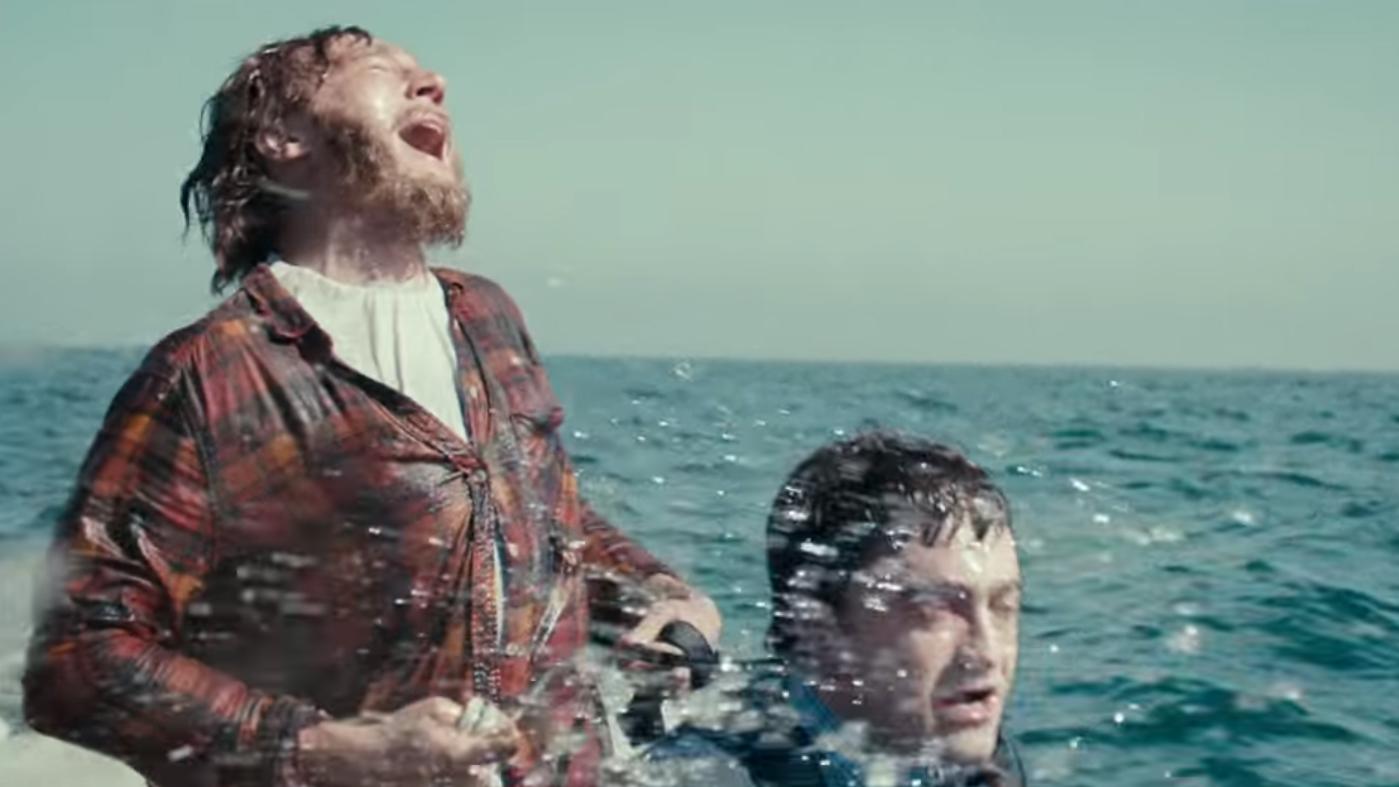
This is a movie with a prodigious amount of farting. And, yes, I thought most of the farting was funny. And yes, I also thought the idea of a corpse being ridden as a jet ski was downright hilarious, especially when Hank pulls down the corpse’s drawers to allow its bare butt to go full-throttle. Yes, that really happened, and yes, I laughed so hard that a stray French fry remains lodged in my sinuses to this very day.

In case you haven’t seen the movie, here is a quick, spoiler-free synopsis: Hank is stranded on an island contemplating suicide when he sees a male corpse wash up on shore which turns out to be weirdly half-alive though nearly immobile, and the two develop a friendship as the duo—Hank and Manny—try to find their way out of the jungle by utilizing Manny’s rigor mortised limbs as wood choppers and methane-producing, versatile bum as a jet-ski and fire-starter; leaving plenty of time for Hank to teach Manny about life, opportunity, love, farting, courage, and fear until Hank finally ends up exploring his own internal landscape—‘unlearning what he has learned’—and recognizing his true self as he comes to terms with the reality and/or delusion (I’m not spoiling it!) of his experiences with Manny which appear to go back-and-forth between psychosis-lucidity-psychosis-lucidity until Hank ultimately releases his inhibitions, expresses his desires, and accepts and affirms himself despite the confusion and possible rejection of his society.

Deep breath.

This movie was a bromance of the highest order with full-on hugging, dancing, rugged survival, avowals of life-long loyalty, drinking of torrential spit from each other’s mouth, and a random underwater kiss that ignited the butt-farting (again) and saved their very lives. Farting. Vindicated.

The question many might ask themselves upon finishing the movie is best phrased by one of the character’s exclamation upon an encounter with this strange scenario, “What the fuck?” We in the theater all nodded our heads in agreement with this sincere and apropos question. There was no overt answer to the question in the movie, but I believe that there is a strong point to the movie though it degenerated quite willingly into complete and utter nonsense at times. But despite this decoy, it returned to its motifs with a more solid punch for every twist.

This story of a man and his corpse explores two themes: 1) bro friendship, and 2) self identity.

1) Bro Friendship


Manny: “If my best friend hides his farts from me then what else is he hiding from me, and why does that make me feel so alone?”

Many men aren’t comfortable with their feelings for their homies. Back in the day, Arabs consummated deals by placing their hands curiously close to the other party’s ball-sack. Socrates and his ilk had no problem proclaiming love for their brethren by wrestling naked. Aristotle went so far as to say that a friend is “a second self.” Christianity’s Apostle Paul—St. Homophobe himself—declared that men should “greet each other with a holy kiss” (with the understanding of course that “the tongue should lie dormant in such blessed mouthing lest his Lordship Caesar should learn of it and want to ‘get up on it’” (I Thessalonians 19 something). Walt Whitman made male bonding even more socially acceptable by cloaking it in his reverence for Lincoln and a Grizzly Adams persona by which he became widely considered as a man’s man with “ne’er a proclivity towards ass-washing.” That brings us right up to the era of buddy films like Good Will Hunting and Lord Of the Rings. The rest is history and mostly legal: guys can like guys, and guys can really like guys.

So it’s all cool, bro-love, right? Well, not yet apparently. People of the modern age are in general still struggling to understand their complex natures, not to mention complicating that search for identity with the multiplied problems of fathomless dimensions of societal relationships with other fucked-up people. If it takes a lifetime or more to “know thy fucked-up self” as Socrates put it, it will take many more lifetimes to “know thyself in the context of other fucked-up selves.” But we don’t have much time, and life gets thick, quick. Guys aren’t always sure about how to connect best with other people, not to mention other people with penises. Watch Fight Club. And for the record, girls aren’t sure about these things either. Watch Bridesmaids. And everything in-between. There, I don’t think that oversimplifies things at all.

Manny: “Girls must be so nice to let guys do all these things to them.”

When we say ‘bro’ most people probably refer to males, but the word ‘bro’ is a reference to a type of friend-relationship that is like family and ideally unselfish. Bros are bros to bros who don’t need them because they have a gaping hole to fill (just in case you didn’t catch that….no pun intended). Bros need bros to just be bros and nothing else. Bros are there when the going gets tough, and bitches be bitchin, and bastards be bastarding. Sometimes a guy (gender neutral) just needs another guy (gender neutral) to be a friend and not require them for ulterior motives or sexual intimacy.

In a nut-sack, that’s what the whole bro thing means. We all want to have at least one pure friendship with loyalty and love that’s not about—what Manny referred to as—“boobs, vaginas, butts.” Or penises for that matter (“Manny, I think your penis is guiding us home!”). Or any of the other parts of the body that human erotica transmogrifies into something to lick or ejaculate on. Bromance is about keeping things completely Platonic so that both parties are bringing something to the table, and leaving each other alone at the end of the day. It’s not sexual, or parental, or dependant, or enabling, or parasitic, or domineering. It is true, secure friendship of separate selves.

Manny: “I'm scared because I fear if I die I might really miss you.”
Hank: “Oh you're the worst.”


So, this film is NOT about farting. Merely. I mean, it’s definitely about farting, but it’s not JUST about farting. There’s more. Lot’s more.

2) Self Identity


Manny: “Oh God I'm disgusting. My body is disgusting.”

Homo Sapiens are gross. And not even in the immoral sense always, but just in the ‘plain nasty’ sense. Movies, meta or method as they often are, still cannot quite approach the metallic taste of reality. Our Victorian puritanistic toilet paper and pretended virginal innocence to our rank crevices and odors are much more absurd than anything in this movie, and our false-piety is a complete denial of our physical grotesqueness, office gossip, barstool confessions, church hypocrisy, and political selfishness. Oh, we are mostly fine being oblivious to ourselves. Joseph Campbell— that great mind that unified myths and stories from around the world and condensed them down into recognizable, recurring themes—believed that even our most horrific stories seldom wish to plunge into the inhumanity of our existence. “Generally we refuse to admit within ourselves, or within our friends, the fullness of that pushing, self-protective, malodorous, carnivorous, lecherous fever which is the very nature of the organic cell.” We’re gross.  And because we are disgusting, and because we don’t like smelling our own excrement, we mold our excrement into devils, ghosts, zombies, hitlers, trumps, step-parents, cool kids, and Teletubbies. According to Campbell, the ogres in our stories are “reflections of the unsolved enigmas of our own humanity.”

But is critical and necessary that we come to terms, to some extent, with our humanity and inhumanity. We must, at some point, explore our dark places if we are ever to find our way. The poet W. S. Merwin wrote that all light gathering leaves are the direct result of roots saturated with darkness, and that humans must grow by “touching the darkness of their whole story from which their leaves open.” The coexistence of beauty and ugliness, good and evil, love and hate, life and death has fascinated people throughout history. Why? Because we can’t seem to escape our fears and filth which dwell side-by-side with our most wholesome traits and cherished hopes. This is so damn hard to admit to ourselves. So we shroud our self-confession in story which helps to soften the blow by a forced, though unconscious, dissociation. Cognitive dissonance and dissociation can be a healthy defense against the bombardment of pessimism and nihilism, but it must be transcended frequently for the sake of a unified self and an honest look at our situation which affords an opportunity to change things for the better.

That’s why farts. Cuz us.

There may be a Nietzschean flare to this whole caper. Friedrich Nietzsche’s character, Zarathustra, sympathetically carried around a friend’s corpse for a while in Thus Spoke Zarathustra until he came to the conclusion that he was finished with “corpses, herds, and believers” in favor of companion-creators. Jesus himself told his followers to “let the dead bury the dead” as a way of embracing a life free from the dead-weight of people-problems (what a dick). Moving on from the corpses—dead-ends and fruitless appendages— of our lives is certainly a recurring archetype in many cultural narratives. But the larger arc of this story would indicate that the ‘adventures of Hank and Manny’ is a simple story of friendship, even if a tad apparitional at moments. Their world’s rules often seem to change from one scene to another, but the writers are under no obligation to be consistent. “A foolish consistency is the hobgoblin of little minds” (Emerson). Come at me.

Manny: “I have a lot of questions about all the things you just said.”

It is, on the surface and near the bottom, a story about a bro being allowed to love a bro. Hank’s neuroses prevent him from enjoying masturbation, being able to accept his mother’s death, expressing his feelings of affection, and farting in front of people. He doesn’t know himself or accept himself. But his stiff friend changes all that. You can watch the film to discover if Manny is real or just another Wilson (from “Castaway”), but the scenes are clearly illustrative of how friends accept each other, mirror back to each other traits that only a friend can disclose, provide a safe place for the risk of exposure, become each other’s compass when lost, wipe each other’s tears, drink each other’s spit, and accept each other—farts and all. Well, most of that.

We are a lot of things to each other including resource, support and reflection. We are each other’s Swiss Army Men and women. We bring each other to life.


“My name’s Manny and this is my best friend Hank. I used to be dead and he brought me back to life.”

Tuesday, June 21, 2016

Review of Ada Limon's "Bright Dead Things"


I first read Limon’s poem How To Triumph Like a Girl in a magazine called The Sun—a weird little creative writing periodical that was sent to my home probably by accident, and in which I connected with very little until I stumbled upon Limon’s masterpiece. If you haven’t read it, you need to.  The poem, not The Sun. God, not The Sun. The poem had an emphasis on woman-power, but as a man I felt equally inspired and in awe of human strength and self-belief.

I read a lot of poetry, but this little beauty stopped my world's rotation for a few minutes. So simple and profound. I nibbled on it for days like a sustaining trail mix in a hostile jungle.  Poetry as condensed, creative, and courageous words are important to those of us who feel like we don’t have enough genius or time to catch all the ideas and feelings that run like water through unconscious fingers.

Wait a minute. That was genius. I want to thank my family, my editor, the Academy, and any one of the gods of the top ten religions.

So, I bought the book. Many of the poems in this book delivered the same seismic wallop as “How To Triumph...” Limon is great at appreciating life while complaining about the sucky stuff in a way that doesn’t completely coagulate into mere bitchiness. It’s crude enough to be authentic, but even when it gets a little weird (e.g., squatting to pee in the poem “Service”), it feels like it was about time for someone to piss on the rules. (Pardon the phun…I did mention I’m a certified genius, write?)

I loved Limon’s criticism of the evasiveness and self-loathing of many constricting forms of religious belief. Life is inscrutable but beautiful, and life lived with open-eyed hopefulness—“the sweet continuance of birth and flight in a place so utterly reckless…How masterful and mad is hope”—is infinitely preferable to adopting a traditional faith by which one can pretend to “fix their problems with prayer and property.”

The benefits of her humanistic/naturalistic/agnostic life include:

“…[a] new way of living with the world inside of us so we cannot lose it, and we cannot be lost.”
“…nesting my head in the blood of my body…I relied on a Miracle Fish, once…that was before I knew it was by my body’s water that moved it, that the massive ocean inside me was what made fish swim.”

The coup de grace to fundamentalist religion arrives in a description about a time in her life when she tried believing in prayer as tradition suggests, but she couldn’t make it work.

“There was a sign and it said, This earth is blessed. Do not play in it. But I swear I will play on this blessed earth until I die.”

Sounds like a good idea.

The play part. Not the die part.

Wednesday, January 13, 2016

Review of Humans of New York


This is not a coffee table book. It looks like one, but it’s not. It is a masterfully simple summary of modern human experience and the current evolutionary status of homo sapiens in photos and short stories. It is not a coffee table book in that it ought to be taken seriously and read in earnest by all serious readers. But I guess in one sense it IS a coffee table book in that it ought to be, and can easily be, read by anyone no matter how much they normally read.

I have to admit, I was surprised at how gorgeous-ugly-provocative it all turned out to be. Searching might even be a good word for how it works on the reader. You can’t read it all through in one setting—or maybe you can, but shouldn’t. You have to put it down to digest, and keep coming back. Otherwise, you miss it. I was moved to tears several times. It’s not that the entire thing is profound. Rather, it was a perfect blend of the trivial and mundane, hysterical and hilarious, trite and bizarre, insane and beautiful, horrific and courageous, and sickening and inspiring qualities that make up the still-undefined and open-ended question of what it means to be human. I was actually surprised at how finely tuned its poetry and portraiture was. I don’t know how Stanton does it so well. I imagine that it’s not as easy as it looks. I doubt that even 10% of his interviews or portraits made it to print. It couldn’t have. Every line seemed surgically cut and pasted with tweezers, needles, and magnifying glass to give the impression of effortless storytelling and to get the letting-life-tell-its-own-tale look so precisely. I found myself reading out-loud to my family, sending people texts of some of the pictures and stories, and planning to use it for group discussions.

Stanton doesn’t force the stories to paint the loveliest picture of life at any cost. His humans come across as hopeless, depressed, evil, and oozing with tar and darkness. But they also come across as courageous, loving, pure, hopeful beings of light. There’s something in the book to sicken even the most optimistic; but other things to fill even the most nihilistic with joy. The unresolved dilemma of human meaning might be one of the most unsettling features of the work. Reading it, we’re not sure if humanity is a good thing or a bad thing. This is where Stanton is genius. He offers no solutions. He lets it play out. All the loveliness and horror do their own work in each reader. No doubt he believes that the light will prevail against the dark, but the conflict is real and at times very disheartening. I still can’t shake the memory of the guy who said that he had to get used to spending life alone because he was obese, relating that his first few therapy sessions were filled only with crying. Or the principal who made each of her students stand up in school while she told them one by one they mattered. Or the boy who said that he’ll always remember the day when no one showed up to his 10th Birthday party. Or the old woman who cheerfully noted that today there were ducks instead of pigeons eating the bread she threw.

The book runs through the dizzying spectrum of human emotions in all their colors and shades; and we’re left feeling a rich, deep, wounded, but purposeful sort of acknowledgement of the value and vicissitudes of life. It’s as if Stanton is documenting our joys and pains and saying from his individual but validating presence and work, “I see you, and your experience if valid.”

Or something like that. Or maybe his message is something more like, “You’re not alone.” I’m reminded of Robert Frost’s Question:

A voice said, Look me in the stars
And tell me truly, men of earth,
If all the soul-and-body scars
Were not too much to pay for birth.


Somehow Stanton’s work leaves us with an impression that the scars aren’t too much to pay for birth. Not by a long shot.

Sunday, December 13, 2015

Review of Catch-22


My advice to anyone who wants to glimpse the brilliance of Heller in half the time and twice the concentration: read Vonnegut.

The irreverent and critical style of Heller is amazing in some ways, especially considering the uptight milieu in which it gained ascendance, and at times it was quite hilarious and illuminating, but unfortunately too much  of it amounts to 500 pages of low-hanging puns and cheap shots to slog through to unearth the gems. Some of his one-liners make his works worthwhile though, and while reading I stay reasonably convinced that he knows what he’s doing and I just need to lighten up. Even so, it is convoluted and laborious for the most part, and I found myself wanting it all to be over after the first hundred pages. I would be embarrassed to say how many days this went on for me, and how many books I started and finished before I put this one to rest. I only hope some of the quotable quotations I put in my back pocket get used in this lifetime, because it is my only justification for the book.

All in all, there just too much great literature that’s current and probably more impactful for someone to waste too much time on this. Hate saying it, but it’s probably past its prime and ready to take its rightful place as one of the ‘classics’ that everyone knows about, but nobody reads.

Ashes to ashes, dust to dust.

Some of the best lines from the book:

And if that wasn’t funny, there were lots of things that weren’t even funnier. (17)

He had decided to live forever, or die in the attempt. (29)

‘You mean there's a catch?'
'Sure there's a catch,' Doc Daneeka replied. 'Catch-22. Anyone who wants to get out of combat duty isn't really crazy.'
There was only one catch and that was Catch-22, which specified that a concern for one's own safety in the face of dangers that were real and immediate was the process of a rational mind. Orr was crazy and could be grounded. All he had to do was ask; and as soon as he did, he would no longer be crazy and would have to fly more missions. Orr would be crazy to fly more missions and sane if he didn't, but if he was sane he had to fly them. If he flew them he was crazy and didn't have to; but if he didn't want to he was sane and had to. Yossarian was moved very deeply by the absolute simplicity of this clause of Catch-22 and let out a respectful whistle.
'That's some catch, that Catch-22,' he observed.
'It's the best there is,' Doc Daneeka agreed. (46)

Like Olympic metals and tennis trophies, all [military awards] signified was that the owner had done something of no benefit to anyone more capably than everyone else. (72)

Clevenger was dead. That was the basic flaw in his philosophy. (104)

People knew a lot more about dying inside the hospital and made a much neater, more orderly job of it. They couldn’t ; dominate Death inside the hospital, but they certainly made her behave. They had taught her manners. They couldn’t keep Death out, but while she was in she had to act like a lady…People bled to death like gentlemen in an operating room, or expired without comment in an oxygen tent. (166)

“I’m cold, Snowden had whimpered. I’m cold.”
“There, there,” Yossarian had tried to comfort him. “There, there.” (166)

There were billions of conscientious body cells oxidating away day and night like dumb animals at their complicated job of keeping him alive and healthy, and every one was a potential traitor and foe. (172)

He could start screaming inside a hospital and people would at least come running to try to help; outside the hospital they would throw him in prison if he ever started screaming about all the things he felt everyone ought to start screaming about, or they would put him in the hospital. (172)

Each day he faced was another dangerous mission against mortality. (175)

General Peckem even recommends that we send our men into combat in full-dress uniform so they’ll make a good impression on the enemy when they’re shot down. (219)

You put so much stock in winning wars…The real trick lies in losing wars, in knowing which wars can be lost. (245)

There was no way of really knowing anything, he knew, not even that there was no way of really knowing anything. (The chaplain, 266)

Did it indeed seem probable…that the answers to the riddles of creation would be supplied by people too ignorant to understand the mechanics of rainfall? (285)

He wished that he could be young and cheerful, too. And it wasn’t their fault that they were courageous, confident, and carefree. He would just have to be patient with them until one or two were killed and the rest wounded, and then they would all turn out okay. (regarding Yossarian’s hardened, military cynicism beside the buoyant, courageous young recruits, 349)

He felt awkward because she was going to murder him. (394)

When you added them all up [the good people with the bad] and then subtracted, you might be left with only the children, and perhaps with Albert Einstein and an old violinist or sculpture somewhere. (413)

He felt goose pimples clacking all over him as he gazed down despondently at the grim secret Snowden had spilled all over the messy floor. It was easy to read the message in the entrails. Man was matter, that was Snowden’s secret. Drop him out a window and he’ll fall. Set fire to him and he’ll burn. Bury him and he’ll rot, like other kinds of garbage. The spirit gone, man is garbage. (440)

When I look up [for ideals] , I see people cashing in. I don’t see heaven or saints or angels. I see people cashing in on every decent impulse and every human tragedy. (445)

Monday, August 17, 2015

Review of Shaw's The Adventures of the Black Girl and Her Search For God


In a sentence: A strong African woman casts off the restraints of a slave’s religion, challenges whitey’s gods, and pushes through to a way of life that is more natural, productive, and happy.

It doesn’t take long for nearly every intelligent author in the course of their career to weigh in on the one topic most try to avoid until they have had at least a small amount of success under their belt. The question of religion and of God are nearly inevitable in an author’s career, and I enjoy the challenge of searching/waiting for works which reveal authors’ best kept biases and most petty/profound insights. Sometimes I am devastated by the inanity and childishness of the reveal, and other times I am deeply moved and persuaded that there is more to the author than her works generally exhibit. Either way it’s entertaining.

So I was excited to stumble upon a work of George Bernard Shaw that performed quite well on this front. Mr. Shaw has thrown his hat in the ring of authors who have spoken out quite bluntly about God and religion, and he pulled no punches. Not only did Shaw tangle with millennia of Christian tradition—a.k.a. ‘God’—in the epilogue of the book, but he also slammed his atheist brothers and sisters for presuming to banish transcendent ‘meaning’ groped for in a mythos, and castigated agnostics for not committing either way and thinking to sidestep the question altogether (“mere agnosticism leads nowhere”). This much was made explicit only in the essay at the end of the book about the failure of modern Christianity, severed as it is from its original context and embellished and contorted in order to fit two millennia of evolving sensibilities and changing environments. But the beginning and middle of the book didn’t make the final comments any easier for the faithful to swallow.

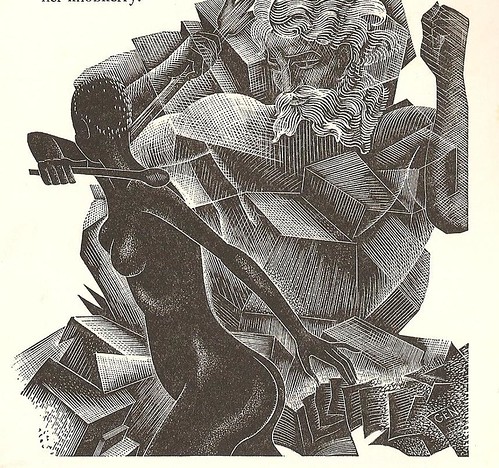
Shaw’s heroine, called ‘the Black Girl’ throughout, is a smart, strong, African woman with as healthy a glow to her spirit as to her earth-strong skin and body. She was, in Shaw’s words, “a fine creature, whose satin skin and shining muscles made the white missionary folk seem like ashen ghosts by contrast.” And with this social commentary on the rooted superiority of African blood, body, and brain compared to the ‘ashen’ feebleness of their western ‘saviors’, the author sets up a contest between his protagonist the Champion of religion—namely, God. The Black Girl had been converted to Christianity by a sad, single missionary woman who had found no satisfaction in her life, and the Black Girl decides to go travelling through her jungle to see if she could find the real God of the Bible that the missionary had depicted. She strides off into the jungle, her knobkerrie in hand (a sort of club with a knob-tip used in hunting and battle), naked and shameless as the earth who mothered her.

Throughout the story she meets with different versions of the God of the Bible, each representing a successive stage of god-progression from blood-thirsty Lord of Hosts, to the God of Job and Micah, to the ascetic and passive Jesus who speaks of a kind of love that consumes individuals for the sake of the collective and frees no one. She debates with each of these gods, and ultimately moves on in search of a more perfect deity that offers more answers.

Perhaps the most interesting part of the story is when the Black Girl discusses God with a few enlightened westerners, and is told by one of the more honest ones that it were best that the Africans—who were “stronger, cleaner, and more intelligent”—not be taught to believe in the “simple truth that the universe has occurred through Natural Selection, and that God is a fable.” Why would this behoove the Westerners to teach? In the words of one pale-thing, “It would throw them back on the doctrine of the survival of the fittest…and it is not clear that we are the fittest to survive in competition with them...I should really prefer to teach them to believe in a god who would give us a chance against them if they started a crusade against European atheism.”

And there Shaw has put it about as succinctly and potently as he could. The Black Girl has felt the bottom of Christendom, and is ready to break out of the religious labyrinth that had been designed for the Third World by Western imperialists (though I don’t believe that the suppression of Third World freedom by Western religious controls is necessarily a conscious thing in all cases, but I wonder if white faithful folk would change their tune if they weren’t the saviors, and felt more in need of the saving). The Black Girl finds no theology which could deliver to her the perfected essence of the imperfect, traditional, Christian God with its heterogeneous limbs, faces, and purposes. The God she seeks doesn’t exist, and she ends up marrying a good Irishman who believes that “God can search for me if he wants me” (not bad terms to be on with God, if God is good that is). She later becomes a mother, reflects on the futility of wasting her life making assumptions about God and chasing mirages, and in the distraction of living her life and taking care of her family and children, completely loses interest in the search for a God whose absence didn’t ultimately affect her much. Later, after she had raised her children, she considers again taking up the search. But “by that time her strengthened mind had taken her far beyond the stage at which there is any fun in smashing idols with knobkerries.”

A brilliant little ending for a brilliant little book about the triumph of humanity over a few of its stubborn and isolated beliefs. It’s not that Shaw had no appreciation for Christianity—“at worst the Bible gives a child a better start in life than the gutter”—but he urged his fellow Sapiens to put behind them the cruder elements of a faith that must be outgrown, and make progress in the search for what William James called, “the More, and our union with it.” He knew the danger of a closed mind, and when one or more people are not willing to move forward and question tradition, things like Christian religion and the Bible become a little more than an impediment to growth—“[if] we cannot get rid of the Bible, it will get rid of us.”


Now all I need is to find me a knobkerrie and crack some ignorant skulls with it. And…I have learned nothing.

Thursday, June 25, 2015

Review of Erik and Joan Erikson's "The Life Cycle Completed--Extended Version"


Erik Erikson can drive a person mad with his florid language and abstractions, and his antediluvian sexual stages are nearly nails in his coffin (lo-rest-his-so), but the man and his wife were a force of nature. He never finished his bachelor’s degree, but he knew what it meant to be human. Who does that? The sense kept washing over me that he was jumping ahead of empirical data and taking hold of a reality-in-itself that transcended his case studies. I can’t help thinking that, even when he was wrong, he was right. I personally think he’s bigger than psychology, perhaps fitting more the philosopher-sociologist type with his wide-sweeping anthropologic and reality-unifying theories.

His 8 stages are brilliant, but I think they are basically restatements of the pulse of human ‘becomings.’ The stages represent an opportunity for each person to ‘become more’ or ‘become less’ in the world.

•             Trust (becoming more) vs. Mistrust (becoming less)
•             Autonomy (more) vs. Shame (less)
•             Initiative (more) vs. Guilt (less)

You get the picture. Apparently Joan did too when she wrote, “I am persuaded that only by doing and making do we become.” Each stage either sees a person desiring to become larger with more involvement in the universe by confirming and building on the freedom and success from an earlier stage, or the person desires to withdraw and cover their wounds, to avoid becoming an inflated target and insulate themselves against the hostile environment that is slowly (or quickly) eroding their ego and sense of capability. As an aside, I was explaining this to my 8-year old daughter, and when I asked her what she thought would happen if an infant doesn’t trust its world and begins to withdraw, she answered, “They won’t learn!” This is true, and perfectly describes the stunted growth of a psyche that fears the world and its presence in it. Sartre and the existentialists would have had a few things to say about this, as their definitions of an inauthentic and dysfunctional human being relate closely to those who are attempting to escape from their essential freedom and suffering in the world (without success).

And I have to give a shout out to Joan Erikson (sup Joanie babe!!) for being willing to go back and modify the 8th stage based upon her first-hand account of it which neither she nor Erik could have augured from their 40-year-old-or-so perspectives when they wrote Life Cycle Completed. Like a boss—at 93 years old—she scrawled out a new definition to ‘wisdom’ and ‘integrity’, representing them not merely as virtues—wispy, spiritual attributes of the distanced-from-life—but as qualities of someone who is ‘in-touch’ with life and it’s meanings in a very intimate and mystical way. She kicked ass for old people the world over, and made her voice heard above the melee of the young, proud, and heedless. Joanie babe, if you weren’t dead and rotted, I’d kiss your un-rotted face for your bravery and un-rottedness!

Quotes From the Book:
Epigenesis—step by step growth and gradual differentiation of parts. In embryology as well as psychology, each organ or trait has its time of origin—a factor as important as the locus of the origin. If the eye, said Stockard, does not arise at the appointed time, “it will never be able to express itself fully, since the moment for the rapid outgrowth of some other part will have arrived.” If the organ misses its time of ascendance, it is not only doomed as an entity, it endangers at the same time the whole hierarchy of organs. The result of normal development, however, is proper relationship of size and function among all body organs. (summary with quote)
A sense of defeat [in early childhood]…can lead to deep shame and a compulsive doubt whether one will ever be able to feel that one willed what one did—or did what one willed. (37)
[Ritualization is a way of saying] ‘this is how we do things’…[and has] adaptive value...in the social process...that must do for human adaptation what the instinctive fit into a section of nature will do for an animal species. (42)
[Parents are the first to] help evoke and to strengthen in the infant the sense of a primal other—the I’s counterpart. (44)
The mutual recognition between mother and infant may e a model of some of the most exalted encounters throughout life. (45)
I submit that this first and dimmest affirmation of the described polarity of the ‘I’ and ‘Other’ is basic to a human being’s ritual and esthetic needs for a pervasive quality which we call the numinous: the aura of a hallowed presence. The numinous assures us, ever again, of separateness transcended and yet also of distinctiveness confirmed, and thus of the very basis of a sense of ‘I’. (45)
Play is the infantile form of the human ability to deal with experience by creating model situations and to master reality by experiment and planning. (51)
[Adults, too, play] with past experience and anticipated tasks, beginning with that activity in the autosphere called thinking. (51)
Hope connotes the most basic quality of “I”-ness, without which life could not begin or meaningfully end. (62)
In old age a retrospective mythologizing…can amount to a pseudointegration as a defense against lurking despair. (65)
An immense power of verification [in mature adulthood] pervades this meeting of bodies [sex] and temperaments after the hazardously long human preadulthood. (70)
It seems that the stage of generativity, as long as a threatening sense of stagnation is kept at bay, is pervasively characterized by a supremely sanctioned disregard of death…Youth and old age, then, are the times that dream of rebirth, while adulthood is too busy taking care of actual births and is rewarded for it with a unique sense of boisterous and timeless historical reality—a sense which can seem somewhat unreal to the young and to the old, for it denies the shadow of nonbeing. (80)
The problem is such that so basic a sense of centrality [of the ego] depends for its renewal from stage to stage on an increasing number of others: some of them close enough to be individually acknowledged as an ‘other’ in some important segment of life, but for the most part a vague number of interrelated others who seek to confirm their sense of reality by sharing… (89)

I am persuaded that only by doing and making do we become. (Joan Erikson, 127)

Saturday, April 25, 2015

Review of The Structure of Scientific Revolutions


Nothing I’ve read to date on the the subject of diversity in human perspective comes near to being as eye-opening as this work has been for me. It is probably still one of the brightest lights on the subject, and continues to cause waves in our time as it did in the 60’s when it was severely controversial. It danced on the graves and sacred places of logical positivism (the idea that we can approach absolute reality by pure reason), surpassed post-positivist epistemologies like Karl Popper’s theory of falsification which posited that human ideas only change when we find something wrong with them, and caused bedlam among those who opposed Nietzschean relativism and postmodernism in general. In fact, this work and its ideas are still wreaking havoc among those who attempt to brace the door against the tsunami of an already entrenched postmodernism. The judgment for those who don’t adapt and/or capitulate to a more virile paradigm is severe in any system, but in Kuhn’s it is phrased as an inevitable path towards isolation, imitation, and parasitism. Even if late-adopters finally acquiesce to the novelty of a new paradigm, it may be too late to ‘go native’ with it. An unwilling imitator “may use the new [paradigm] nonetheless, but he will do so as a foreigner in a foreign environment, an alternative available to him only because there are natives already there. His work is parasitic on theirs, for he lacks the constellation of mental sets which future members of the community will acquire through education.” Of course, I’m thinking of latest wave of materialistic scientists, who I love and revere for their genius in their own fields, but who refuse to acknowledge the debt they owe to great thinkers like Wittgenstein and Sartre whom they imitate but don’t thank.  

Regardless of who is who in season 5 of “Paradigm Wars”, the work concerned with in this review—The Structure of Scientific Revolutions—explicates the reality of paradigm competition, paradigm incommensurability, and the process of paradigm succession. As I said, no one comes close to Kuhn in explaining why different people commit to different ideas, and why they seldom change without life-altering circumstances or crises, and sometimes, not even then.

This may be nicely illustrated by a conversation I had with my daughter recently. We were driving along, talking about the belief system I was raised with, and I was explaining how my worldview changed drastically. I felt strangely honored when she said, “Dad, I’m proud of you.” I asked why. She said, “Because you made it out of a religion. Most people grow old with what they believe, and sometimes never make it out.” Wow. Now, to be honest—and my wife made me admit this—I most certainly planted that idea in her head since this wasn’t an isolated conversation; but for her to put those words together for that moment tells me she understands what powerful things worldviews and paradigms are! The chance of coming to terms with the power of paradigms makes this book is so important for people who can understand it, and for those who can help translate the message to the many who will never read it.

Paradigms

To begin, Kuhn begins by defining what a paradigm is, and how it works. A paradigm is a word rescued by Kuhn from the Greek word paradeigma meaning ‘pattern’ or ‘example’. The contemporary use of the word along with the phrase ‘paradigm shift’ owes the shirt off its back to Kuhn. In Kuhn’s usage, a paradigm is essentially a communal worldview that saves people the task of reinventing the ideological wheel. Paradigms are full of rules, definitions, expectations, values, feelings, and views of the world that are heavily inculcated and therefore deeply ingrained in the mind of each member. Paradigm-imprinting is often unconscious, with implicit thinking patters which are ultimately accepted by the member as ‘the way the world is.’ Kuhn brought to the world’s attention how even academic textbooks are assiduously designed to give the impression that they are unbiased and have arrived at a final convergence of all past paths of knowledge and discovery. But even textbooks are subject to paradigmatic bias. Kuhn points out that there is no cumulative ‘one right way’ to think about the world (a point which he revisits later), but rather there are many different simultaneous paradigms that compete with each other and offer different benefits to members of their community.

Normal Science

Are paradigms, then, merely symptoms of human bias and communal narrow-mindedness? Yes and no. Paradigms offer what Kuhn dubs ‘normal science’—the foundation and compliment for all ‘revolutionary science’ which ushers in new, contending paradigms—and it is this normal science which assists paradigms in functioning unimpaired by every stray doubt or question that plagues the human mind. Within an accepted paradigm an individual can rest on certain principles that they believe are true, and science can begin to test those principles in all their nuances and further articulate the theories present in the paradigm without fear of being rushed or waylaid at every corner.

“The restrictions [of normal science’s range of research], born from confidence in a paradigm, turn out to be essential to the development of science. By focusing attention upon a small range of relatively esoteric problems, the paradigm forces scientists to investigate some part of nature in a detail and depth that would otherwise be unimaginable…[and solve] problems that its members could scarcely have imagined and would never have undertaken without commitment to the paradigm.”

Kuhn cites three things that normal science provides which would be untenable in revolutionary science:
1) Theory fact-finding that is undisturbed, unimpeded, and supported by consensus and advanced technology.
2) Theory fact-matching that is a concentrated and sophisticated form of puzzle-solving within a given paradigm.
3) Theory articulation of the paradigm that provides refined language, rules, tools, and minor revision of paradigmatic theories to keep the paradigm afloat.

Normal science is not designed to produce paradigmatic changes, novelties, or facts that aren’t ultimately assimilable into the paradigm. All findings of normal science are either forced into categories to support a paradigm, or they are dismissed as the errors or as limits of the scientist. The reason for this is that the puzzle-solving urge of scientists, and human beings in general, is irresistible and provides rewards in the form of solution-gratification and recognition. This puzzle-solving urge is enough in itself to busy most people for most of their lives, because in it answers are predictable and achievable. This is in direct contrast to the work of revolutionary science in which problems are reconstituted with no ready formulas for attaining solutions or even a guarantee that a solution will be attainable or recognizable in one’s lifetime. In some sense, normal science is much more productive in research and articulation, but it folds in on itself and stymies the process of actual discovery that so many mistake to be its central purpose.

“The scientific enterprise as a whole does from time to time prove useful, open up new territory, display order, and test long-accepted belief. Nevertheless, the individual engaged on a normal research problem is almost never doing any one of these things. Once engaged, his motivation is of a rather different sort. What then challenges him is the conviction that, if only he is skilful enough, he will succeed in solving a puzzle that no one before has solved or solved so well. Many of the greatest scientific minds have devoted all of their professional attention to demanding puzzles of this sort. On most occasions any particular field of specialization offers nothing else to do, a fact that makes it no less fascinating to the proper sort of addict.”

Augmenting the apparent triviality of puzzle-solving that normal science is obsessed with, basic educational models are designed to condition students to learn ideas by plugging theorems and formulas into applied science—learning by rote and practice—which further solidifies the puzzle-solving mentality. This distances the eventual specialist from any contact with problems or values not originally defined by their community’s paradigm, which definitions are often accepted at face value and remain largely unquestioned.  “Though many scientists talk easily and well about the particular individual hypotheses that underlie a concrete piece of current research, they are little better than laymen at characterizing the established bases of their field, its legitimate problems and methods.”

It is a frightening notion that so-called ‘detached’ scientists aren’t so detached after-all—even the tools and rules used to approach problems are only after all a ‘strong network of commitments’—but we have to remember that this is in accordance with the very nature of humanity which is, ipso facto, anything but detached to its desires and goals. We are irremediably invested in goals and aims, many of which we aren’t even completely aware of, and yet what little awareness of our prejudice we can develop will help us to switch our allegiances in as intelligent ways as we can manage when it comes time.

Discovery

Kuhn, points out again and again that the discovery of new facts which inform new paradigms is not a simple process of accumulating knowledge. Discovery is not merely something that happens when people experience something new. Indeed, discovery happens far later than a first new experience. With new experiences, people are only conscious of a phenomenon which defies established categories as ‘something that has gone wrong’, or an anomaly. Kuhn gives the example of the discovery X-rays. In a normal investigation of cathode rays by the physicist Wilhelm Röntgen in 1895, a piece of lab equipment seemed to arbitrarily glow on the other side of the room. Further investigation of the phenomena, and many experiments later, Rontgen was able to isolate, duplicate, and describe the effect which was caused by X-rays. This discovery was piecemeal, and could not be properly called a ‘discovery’ at those early stages when Rontgen had no idea what had caused the anomaly. With enough research, anomaly gives way to novelty—or repeated anomaly—and novelty gives way to expectation, completing the process of discovery.

The point here is extremely significant: there is no authentic discovery in normal science, because there is no room for anomaly or novelty! “Discoveries [which are] predicted in advance are parts of normal science and result in no new sort of fact [no authentic discovery]… Normal science does not aim at novelties of fact or theory and, when successful, finds none.” Normal science supports, puzzle-solves, and articulates theories within a paradigm, but it doesn’t go off hunting for new paradigms; therefore data that doesn’t fit into an existing paradigm is anomalous until it is either mashed into the paradigm, or it becomes a crisis to usher in a competing paradigm in which to assimilate. Therefore, paradigms—ways of thinking about the world that are bolstered by normal science—are designed to resist discovery! Welcome to the glories of the human brain. This is right-brain, left-brain wars if I’ve ever seen them! Read Ramachandran’s Phantoms In the Brain for a neurological explanation of why and how the brain creates fiction (confabulates) to compose a consistent picture of reality. You can’t make this stuff up! Wait. Yes. Yes you can.

But the pitfalls of paradigms are worth the trouble.

“In the development of any science, the first received paradigm is usually felt to account quite successfully for most of the observations and experiments easily accessible to that science’s practitioners. Further development, therefore, ordinarily calls for the construction of elaborate equipment, the development of an esoteric vocabulary and skills, and a refinement of concepts that increasingly lessens their resemblance to their usual common-sense prototypes. That professionalization leads, on the one hand, to an immense restriction of the scientist’s vision and to a considerable resistance to paradigm change. The science has become increasingly rigid. On the other hand, within those areas to which the paradigm directs the attention of the group, normal science leads to a detail of information and to a precision of the observation-theory match that could be achieved in no other way.”

What Kuhn is pointing out here is that we would not be aware of the need for new constructs if we didn’t have some construct in place, however limited or inadequate, to start sorting through the profusion of data that is present to our senses. How would we know that something has gone wrong, or that we need a new or more accurate metric if we had no standard by which to measure and notice something is awry in the first place? Paradigms are grids of the cosmos which allow scientists to concentrate on specific sections to study at close-range without being bothered about the rest of the universe. By doing this, novelty and anomaly take on real texture and appear in stark contrast against a background of a very well-studied context.

“And even when the apparatus exists, novelty ordinarily emerges only for the man who, knowing with precision what he should expect, is able to recognize that something has gone wrong. Anomaly appears only against the background provided by the paradigm.”

Paradigms, then, are temporary structures—rigid, limited, and ultimately abortive—but without them, humanity could not advance ideologically or scientifically. Every successive generation leaves the old ones behind, but also creates new ones which will, in their turn, be left behind some day. It is the circle of paradigm-life:

The mobs of birth
Avoid our stale perfections, seeking out
Their own, waiting until we go
To picnic in the ruins that we leave. –Wallace Stevens

Crises and Competition

The specific way in which old paradigms gives way to new paradigms is fascinating. Even in the case of complete discoveries—from anomaly, to novelty, to expectation—new data is merely contorted to fit old categories unless a competing paradigm is offered which reframes all data, old and new, to form a new map of the world. Crisis is the harbinger of change. Without crises, no new idea would ever take root because there would be no perceived need for it, and therefore no motivation to do all the hard work required to establish it. Humanity has a strong tradition of staying in bed until the sheets are soiled. For all people, including scientists, “retooling is an extravagance to be reserved for the occasion that demands it,” i.e., ‘if it ain’t broke, don’t fix it.’ And when one considers how deeply paradigms are woven into the fabric of society and scientific methodology, one can understand why ‘retooling’—or completely reimagining the wheel—is so costly.

But crises do finally come in their dark robes and scythes for every paradigm’s soul, in one of many ways. The first symptom of a crisis is often a general sense of inefficiency in areas that once demonstrated the paradigm’s superiority. Here scientific paradigms show their consanguinity with political paradigms in exhibiting breakdown when they have “ceased adequately to meet the problems posed by an environment that they have in part created.” Beyond an intuition that something is awry, there are other more obvious signals. “The proliferation of competing articulations, the willingness to try anything, the expression of explicit discontent, the recourse to philosophy and to debate over fundamentals, all these are symptoms of a transition from normal to extraordinary research [which research works to inaugurate a new paradigm].” What’s further, taste and aesthetic preference can cause people to look up and out. Sometimes the subjective impression that an existing paradigm has become somehow become clunky and unattractively complicated might signal the need for another paradigm that is nice, neat, and simple.

When a crisis is acknowledged in a community, new paradigms are proposed by brave souls who aim to create a system that better incorporates and explains new and old information. This paradigm-rush sees a proliferation of multiple, un-tested versions of traditional paradigms, rules, and all-new iterations altogether,  introduced which might initially seem to complicate things, but actually help to free people from the fear that the rigors of an old paradigm is their only option. “All crises begin with the blurring of a paradigm and the consequent loosening of the rules for normal research.” And the bearers of these gospels of change? Young people with fresh eyes. This works partly because new eyes see clearly the problems that communities become inured to over time, but it also works because new people have not sunk resources, time, and energy so deeply into the old paradigm, nor have they staked a political reputation on defending and reinforcing the old views. And although introducing a new paradigm is difficult and meets with much opposition, it is often still worth the risk because the sense of loss isn’t as poignant if things don’t work out. Loss aversion, a very real behavioral phenomenon which refers to the tendency of people to strongly prefer avoiding losses than acquiring gains, may be a large part of the underlying tenacity of old paradigms, especially when afflicted by crises and faced by alternative paradigms.

Incommensurability of Paradigms

History has illustrated again and again that the introduction of a new paradigm doesn’t bring world peace. The problem is that all new paradigms are only accepted by those who recognize failures within old paradigms. If a failure is not recognized by those who adhere to a paradigm, then it will continue to be bolstered and perpetuated until its adherents have moved on, or are dead. And as long as communities hold together within a paradigm, failures of a view will be compensated for and speciously ‘solved’ by the puzzle-solvers and articulators who find benefit in solidarity itself. It quickly becomes obvious that paradigms are ways of life, and not solely ways to think about life. It is here we see how closely scientific paradigms resemble paradigms within other human studies and endeavors.

“Like the choice between competing political institutions, that between competing paradigms proves to be a choice between incompatible modes of community life.”

A paradigm ultimately reveals itself to be glued together by personal taste and interest, and not merely by claims to ‘truer truths’. This is why Kuhn states that all groups argue in circularities when coming to the defense of why they chose their paradigms. Proofs don’t convince, because proofs are a posteriori explanations of what works and what doesn’t. The best a proof can do is demonstrate that a paradigm works, or provide “a clear exhibit of what scientific practice will be like for those who adopt the new view of nature,” and may not win much merit for logical explanations which every paradigm ultimately develops. Mostly those who find that a paradigm community works or is compelling on some level are those who ‘step inside the circle’ and ‘go native’ with a paradigm. They are those who understand the values, terms, and rules, and who value similar goals and processes. Within every paradigm are defined problems, and proposed solutions, but what happens when people differ with each other about what the real problems are and what a solution would look like? Problems and solutions are essentially human in nature. Nature in itself has no problems or solutions. Problems and solutions depend on the significance human beings place on them, and there never has been nor ever will never be problems or solutions that nature defines for us. And if paradigms, as Kuhn maintains, function to define and solve problems, then it is evident that world views are strictly human constructions and depend as much on our frame of mind as anything empirical and external to us. Normal science, therefore, is about human interest, and not mere detached observation and reportage.

This most personal value and interest that gives a paradigm its existence and imbues it with significance is what makes paradigms ultimately incommensurable with each other. They fundamentally aim at different goals, define success and failure in different ways, and structure their communities to follow specific rules to achieve specific goals. Especially important is how language is customized and everyday terms are defined by a community’s nuanced goals, rules, understandings and expectations. Paradigms are different worlds! This is why Kuhn says that members of different scientific schools “will inevitably talk through each other when debating the relative merits of their respective paradigms.”

And because every paradigm necessarily involves incomplete and therefore partially inaccurate explanations of the universe, the incommensurability only increases. “Since no paradigm ever solves all the problems it defines and since no two paradigms leave all the same problems unsolved, paradigm debates always involve the question: Which problems is it more significant to have solved?” I can’t imagine a question more important or more divisive than that one, and yet hardly a person recognizes that this exact question is even at stake.

Kuhn believed that people of different paradigms essentially inhabit different worlds. Often people’s views of the world are so completely at odds with each other that it’s hard not to believe that they are viewing the same thing at all. It is as if a gestalt switch has been flipped, and where before one saw ducks, now they see rabbits; or where before the one “saw the exterior of the box from above,” they now see “the interior of the box from below.” For example, in very simple, literal terms, a contour map may at first look to a student like mere lines on a paper, but to a cartographer, it’s a picture of terrain. Kuhn uses the history of incommensurable views in Copernicus’ time to further illustrate gestalt.

“Consider, for another example, the men who called Copernicus mad because he proclaimed that the earth moved. They were not either just wrong or quite wrong. Part of what they meant by ‘earth’ was fixed position. Their earth, at least, could not be moved. Correspondingly, Copernicus’ innovation was not simply to move the earth. Rather, it was a whole new way of regarding the problems of physics and astronomy, one that necessarily changed the meaning of both ‘earth’ and ‘motion’. Without those changes the concept of a moving earth was mad.”

New information and different frameworks ‘create’ different vision to view different worlds. “What a man sees depends both upon what he looks at and also upon what his previous visual-conceptual experience has taught him to see.” This goes so far as to affect not only the ideological framework for data, but the supposedly straightforward data itself. Even “the operations and measurements that a scientist undertakes in the laboratory are not ‘the given’ of experience but rather ‘the collected with difficulty’,” which means that facts don’t fall into anyone’s laps, they are sought after and only recognized when they are squeezed into the mold of a prefabricated pattern or idea.

The force of polarization in paradigms naturally increases and reinforces the incommensurability of paradigms, almost irrevocably. Is it any wonder it seems nearly impossible for some people to change their mind on any given subject? The secret about facts is that no fact stands alone. Each is inextricably woven into a vast web of meanings, implications, underpinnings, and cover-ups; and the knots cannot be untied without leaving the whole in tatters. This is why the webs of paradigms are simply abandoned when they fail to work, and quickly replaced by a paradigm that promises better solutions.

Conversion

So how can people change their minds and switch paradigms if their self-reinforcing psychology and genetic protocol to propagate one’s own ideas at the expense of reality keeps confirming the paradigms that they accepted at an early age? What happens when a paradigm is taking water, and it’s time to bail? Well, it’s either adaptation or extinction, and most would rather die before their dreams do. Scientists of the ilk of Copernicus, Newton, Darwin and many others never witnessed a conversion of the masses to their ideology immediately, and countless others were murdered before later generations pardoned them, sainted them, and adopted their discoveries. Quantum theorist Max Planck summed up this tragic truth best in his Scientific Autobiography,

“A new scientific truth does not triumph by convincing its opponents and making them see the light, but rather because its opponents eventually die, and a new generation grows up that is familiar with it.”

Cynics would dismiss the whole mess as a modality of one of the useless extremes of either relativism or bigotry, but a closer look reveals the value of the hard-to-kill nature of human paradigms. Commitment to paradigms, along with the obstinate delusions about their absolute nature, is exactly what makes normal science—puzzle-solving—possible! Without this resolve to stick to the paradigm, no work would ever get done, and the meticulous scrutiny and recording of experimental findings—brute data—that makes the scientific process what it is would be abandoned at the first sign of discrepancy. Imagine a world of fickle, bohemian, flip-flop scientists! Pun most definitely intended!

Science help us. Science help us all.

But for those who do recognize crises in a paradigm and are still young and supple enough to convert to a new paradigm that can solve the old crises, ‘there is a mansion prepared for them, so that where the Solution is, there they may be also.’ But we have to keep in mind that a more accurate and helpful paradigm may introduce new problems, and may not solve enough problems satisfactorily, at least immediately, for all people. In fact, some historical revolutions with proposed solutions initially “created many more problems than they solved…Copernicus’ theory was not more accurate than Ptolemy’s and did not lead directly to any improvement in the calendar.” It is often true that a person who wakes from a worldview must do so “in defiance of the evidence provided by the problem-solving” all around her, and this is done by “faith” in a new way that as of yet hasn’t been established. She then become the pioneer that everyone else watches to see how she fairs, and to witness how her new paradigm serves her. If things go well, they may have a new winner.

Textbook Paradigms and Invisible Revolutions

As a very practical example of the failure to understand competing paradigms, Kuhn strings up textbooks. The best of our science—for all of the scientific community’s claims of detachment, objectivity, and systematic process—is just as subject to paradigmatic provincialism and confirmation bias as any other human pursuit. Kuhn deals very candidly and directly with the fact that school textbooks—which stand as a tool purely intended to convey information and not feelings—are just as prone to prejudice and manipulation of the facts as any other human instrument.

“For reasons that are both obvious and highly functional, science textbooks…refer only to that part of the work of past scientists that can easily be viewed as contributions to the statement and solution of the texts’ paradigm problems…[this] depreciation of historical fact is deeply, and probably functionally, ingrained in the ideology of the scientific profession, the same profession that places the highest of all values upon factual details of other sorts.”

Kuhn spends a lot of time with the textbook problem because it is largely overlooked by many, and perhaps least acknowledged by scientists and the academy. The result is that scholars and laymen alike are wrongly persuaded that humanity’s knowledge of the world is steadily increasing, as opposed to the more likely scenario that science, like everything else, is a constant flux of paradigms slugging it out to the death in a battle royal where the strong, not necessarily the ‘more right’, survive. Essentially, these historical, textbook “misconstructions render [scientific] revolutions invisible” by pretending each revolutionary idea was finally saluted and crowned king upon its arrival by its epoch, rather than viciously attacked for being antithetical to the established. Kuhn argues that this isn’t honest, effective, or healthy. Science and history ought to give a more forthright account of itself, lest, in the words of William James, it “lose[s] truth by this pretension to possess it already wholly.” Not only that, but the creative and pioneering spirit of discoverers are substituted with an idea of gentle inevitability which downplay the role of courage and imagination which subverts and contends with the powers of paradigm. “Until the very last stages in the education of the scientist, textbooks are systematically substituted for the creative scientific literature that made them possible…it is a narrow and rigid education, probably more so than any other except perhaps in orthodox theology.”

But again, the reason for this is that textbooks teach by inculcation, by setting up problems and solutions which students learn formulas to apply, facts to remember, and patterns to recognize. In this way, an existing paradigm is passed on, and a gestalt is reinforced which causes members of the same group to see the same picture. These are the ‘examplars’ that Kuhn refers to, the faux problems that condition students to recognize and reproduce paradigms, and it is completely natural and universal. “One of the techniques by which members of a group…learn to see the same things when confronted with the same stimuli is by being shown examples of situations that their predecessors in the group have already learned to see as like each other and as different from other sorts of situations.” If it weren’t for crises, or, I would add, boredom, which catalyzes a revolution, perhaps nothing would break the cycle of a paradigm’s reiterations and redundancies.

Summary and Conclusions

So what did Kuhn really contribute to science and philosophy? Kuhn successfully contended with and soared above other popular ideas in his day about how to verify the accuracy of a theory or idea. Karl Popper’s “falsification” epistemology was still in vogue, and Kuhn’s competitive paradigms made it clear that an idea need not be perfect, or perfectly validated, for it to work. It was a much simpler test of accuracy than had ever been devised before, but it wasn’t without its consequences. If a paradigm wasn’t ‘right’ because it won in the contest, what’s to say an incorrect paradigm couldn’t pull out in front of the rest and be wrongly celebrated for its veracity simply because it received the largest number of votes? Kuhn saw where this was going, and beat it to the punch: Science and history has no goal, no higher truth towards which it is progressing. He admits that this is not a conventional view, and it can be very disturbing within many paradigms (especially in his day). Yet William James, among others, said as much in his Varieties of Religious Experience, “Nature has no one distinguishable ultimate tendency with which it is possible to feel a sympathy. In the vast rhythm of her processes, as the scientific mind now follows them, she appears to cancel herself.” Kuhn points out that this was the essential findings of Darwin, “The Origin of Species recognized no goal set either by God or nature” (Kuhn). But the idea that the evolution of paradigms is moving away from “primitive beginnings,” revealing a pattern of an “increasingly detailed and refined understanding of nature,” and not necessarily towards anything doesn’t have to be disappointing. It’s all in the way you look at it (go figure). “If we can learn to substitute evolution-from-what-we-do-know for evolution-toward-what-we-wish-to-know, a number of vexing problems may vanish in the process.” In other words, one could say that we are progressing towards knowing more of what we want to know, and as tautological as it sounds, it certainly doesn’t interrupt our rhythms of getting everything we possibly can out of science and intellectual endeavors. If it works, who cares if it doesn’t work the way we thought it should, or it doesn’t reveal what we thought it would reveal? We find it meaningful and productive, and in the end, that may be enough.

But this work goes beyond science by elucidating the ways in which human beings think in art, politics, sociology, philosophy, and religion.  As a matter of fact, although Kuhn states in the Postscript that paradigms in science often operate in some ‘strikingly different’ ways than in fields like art and literature, he admits that he derived the concept of paradigm successions from other fields for the reason that he believed the sciences operated in many similar ways, if in different degrees. This is enough for any thoughtful reader to apply the concept of competing paradigms to all areas of human cognition and action, since it is impossible for humans to work and think—to live!—outside of paradigm or outside a community of other minds. This is precisely what The Structure of Scientific Revolutions is all about, and it is how the Postscript of the second ends.

“Scientific knowledge, like language, is intrinsically the common property of a group or else nothing at all. To understand it we shall need to know the special characteristics of the groups that create and use it.”


It was Kuhn’s way of saying that no idea exists outside of human community—that paradigms ARE human community— and it was his hope that future generations would use this to better understand themselves and each other.